
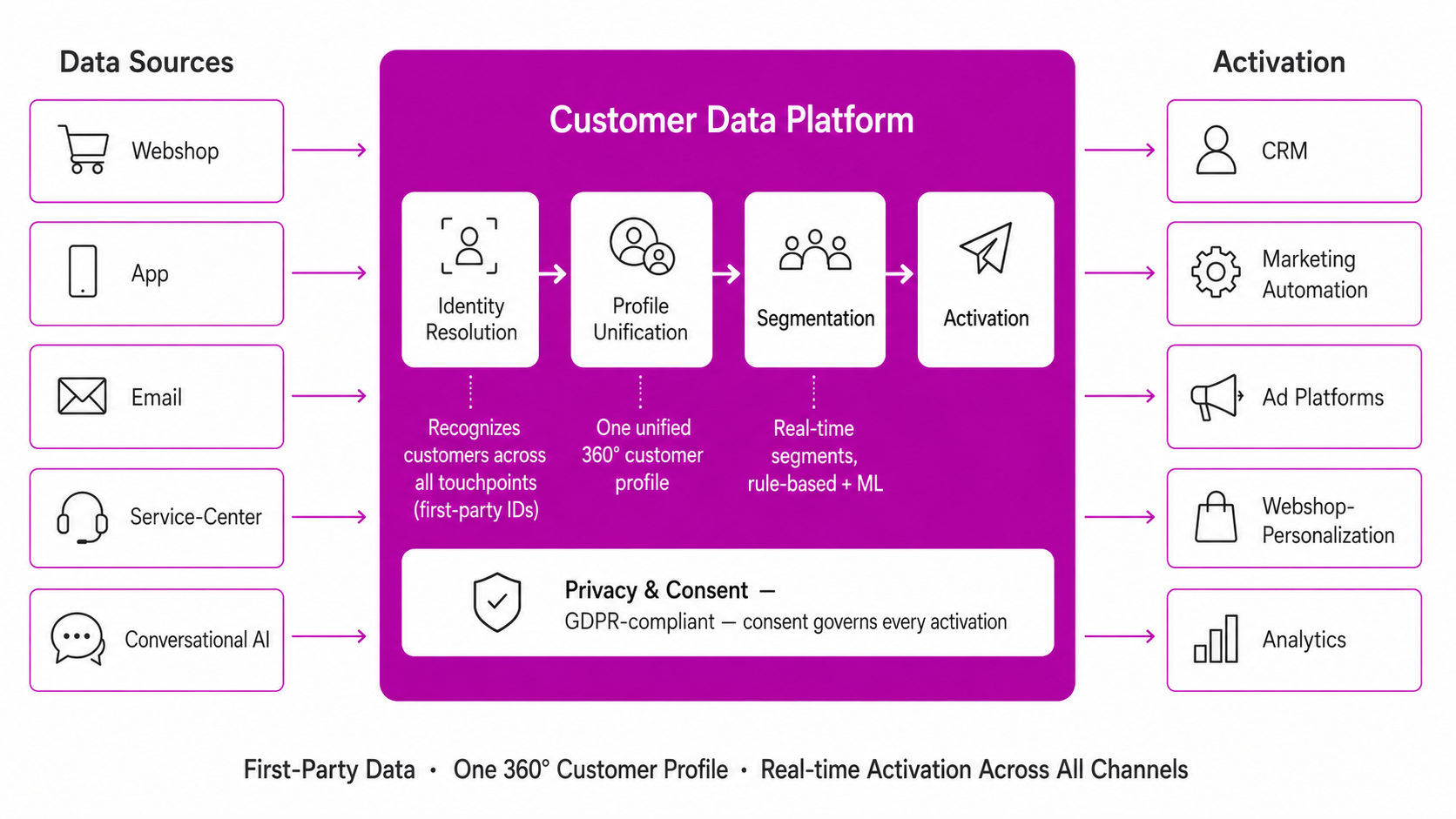
A Customer Data Platform (CDP) brings together customer data from all touchpoints — webshop, app, service desk, CRM, and marketing tools — into one unified profile per customer via first-party IDs. From this central profile layer it drives segmentation, personalization, and activation across every channel — GDPR-compliant.
As the customer-data component of a Digital Experience Platform (DXP), the CDP — together with CMS, PIM, DAM, e-commerce, and conversational AI — forms the unified data and channel layer for consistent brand experiences across every touchpoint.
What is a Customer Data Platform (CDP)?
What sets a Customer Data Platform (CDP) apart is persistence: it does not build a fleeting segment but a durable, complete profile per customer — anonymous and known alike — entirely based on first-party data and kept accessible to other systems. Unlike a CRM (known contacts, sales view) or a DMP (anonymous third-party data), it is the customer-centric data foundation for marketing and experience.
The challenge: Without a CDP, customer data lives in parallel inside tools — web tracking in analytics, orders in the shop, service tickets in the helpdesk, email engagement in the marketing tool. The result: duplicate profiles, inconsistent channels, and blind spots in customer-lifecycle activity.
A CDP solves this: Identity Resolution recognizes a customer across channels, Profile Unification merges all data points, Segmentation enables real-time targeting, and Activation pushes profiles to webshop, marketing tools, and bots — GDPR-compliant and based on first-party data.
Is a CDP worth it?
Customer Data Platforms pay off measurably. Forrester quantified the return on investment for the two leading CDP platforms in independent Total Economic Impact studies:
431% ROI over three years for Adobe Real-Time CDP (with Adobe Experience Platform apps), payback in under 6 months.
Forrester Total Economic Impact, commissioned by Adobe
324% ROI over three years for Microsoft Dynamics 365 Customer Insights, $7.86M net present value.
Forrester Total Economic Impact, commissioned by Microsoft
Numbers like these don’t come from buying the platform. They come from focused use cases and a clean data foundation — the two levers that decide your real ROI.
CDP components at a glance
A CDP combines five functional components. Which are highest priority depends on your current data baseline and first use cases — projects typically begin with Identity Resolution and Profile Unification.
- Identity Resolution — Recognizes customers across all touchpoints (web, app, email, service, bot) using first-party IDs, hashed email addresses, and probabilistic matching. Cookie-free and GDPR-compliant.
- Profile Unification — Consolidates all data points into a unified 360° customer profile: behavioral data, transactions, service interactions, consent state, preferences.
- Segmentation & Audience Building — Real-time segments based on behavioral, profile, and lifecycle data. Rule-based and ML-supported, directly activatable in marketing and channel tools.
- Activation — Activates profiles and segments via CRM, marketing automation, ad platforms, webshop personalization, and conversational AI through native connectors or API.
- Privacy & Consent Management — GDPR-compliant consent, deletion, and access workflows. Consent state flows into every activation — no activation without valid consent.
Typical CDP use cases
CDP projects typically start at one of three use-case clusters. Which cluster comes first depends on your marketing stack, data-integration maturity, and business leverage.
- Acquisition – anonymous-to-known: Connect anonymous-visitor web behavior with marketing activation as soon as an identity anchor emerges (login, newsletter opt-in, order). Anonymous sessions are retroactively linked to the profile, marketing spend is attributed to actual buyers.
- Conversion – cart recovery & checkout personalization: Detect abandoned carts in real time and recover them via the right channels (email, push, retargeting). Personalize checkout flows on profile data — from shipping options to payment methods.
- Retention – lifecycle marketing: Merge order, service, and engagement data into a 360° profile and run automated lifecycle campaigns (onboarding, re-engagement, loyalty, win-back) on real-time behavior — across email, app push, webshop personalization, or bot.
- Marketing efficiency – frequency capping & audience suppression: Enforce frequency capping across all channels, suppress existing buyers from acquisition ads, and uncover audience overlaps between campaigns. Spend marketing budget more deliberately.
- Service – cross-channel consistency: Pass profiles from web, shop, app, and service desk to conversational AI and service agents so bot and agent see the same customer context — no repeated identification loops, no data conflicts between channels.
- Compliance – GDPR-centered consent activation: Central consent storage across all tools, automated deletion workflows on revoke, and audit logs per profile. Activation happens only when consent is valid — everything documented.
CDP maturity model
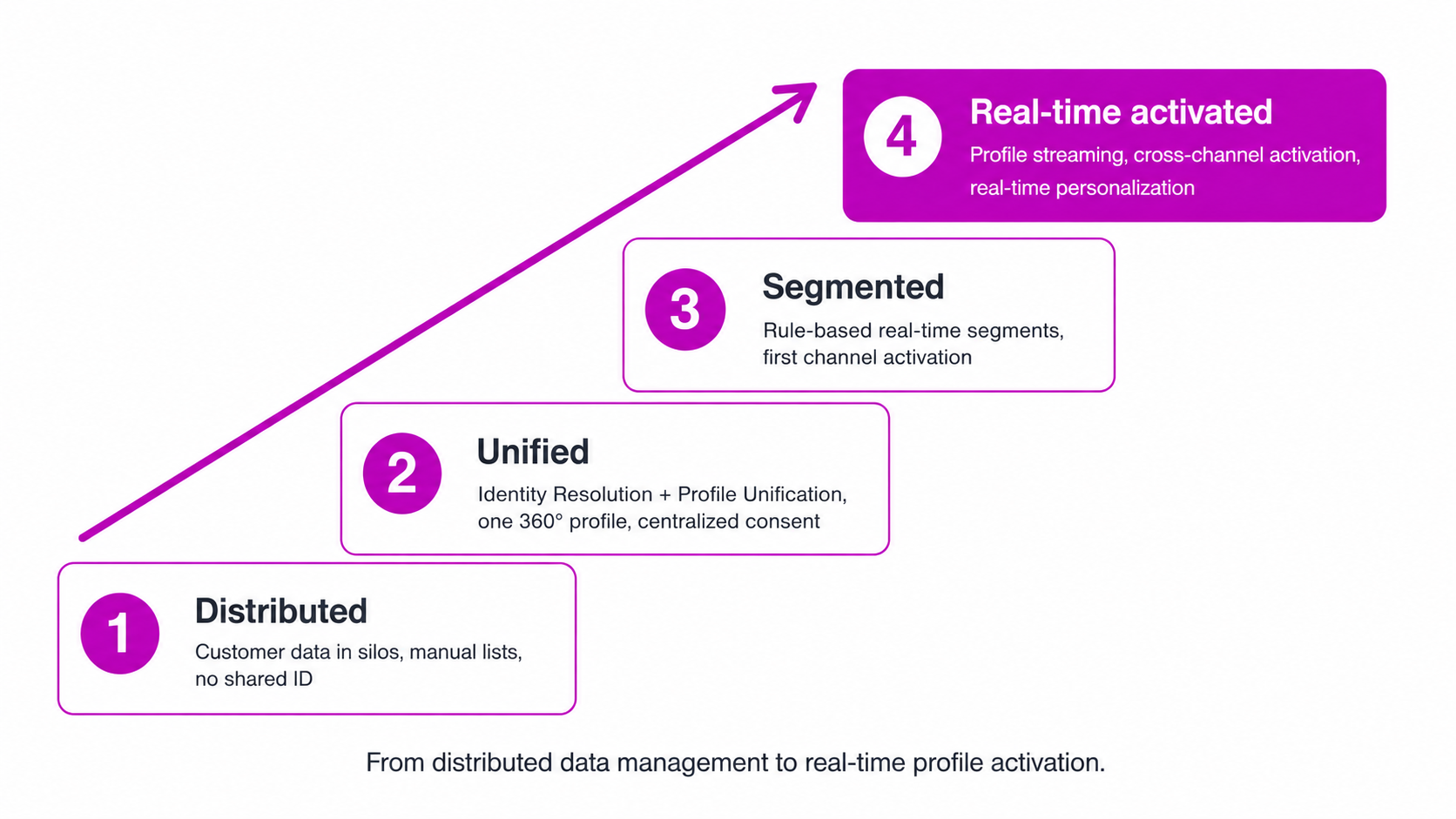
Four maturity levels structure the path from distributed data maintenance to real-time profile activation. Each jump between levels is less a tool question than an architecture and process question — which data sources are connected, how cleanly identity resolution and consent are handled, and how deeply activation reaches into the channels. Where your next sensible step lies depends on channel mix, compliance requirements, and existing marketing stack.
1
Distributed
Customer data sits in silos: CRM, webshop, email tool, and service desk each keep their own lists, often with conflicting states. There is no shared ID and no consolidated profile. Segments are built manually via export and are outdated the moment they are used.
2
Unified
Identity resolution connects the touchpoints via first-party IDs; profile unification consolidates them into one 360° customer profile. Consent is stored centrally and applies across all tools. For the first time, a reliable single source of truth exists — the foundation for everything that follows.
3
Segmented
On top of the unified profile, rule-based real-time segments emerge by behavior, lifecycle stage, and value. The first activation runs into individual channels — for example email journeys or retargeting audiences that update automatically instead of by manual export.
4
Real-time activated
Profiles stream in real time into all channels: web, email, ads, service, and conversational AI. Cross-channel personalization and frequency/suppression logic run automatically and consent-driven. The CDP is no longer a reporting tool but the operational core of the customer experience.
Our CDP services
We guide CDP projects from initial use-case assessment to productive multi-channel rollout — structured in four phases with clear deliverables per phase.
1
CDP strategy & platform selection
We audit existing data sources, identity anchors, tracking setup, CRM/shop/marketing stack, and consent landscape. Use-case inventory with business value. Platform recommendation based on stack fit, scaling requirements, and compliance.
2
Data model & identity-resolution design
Data-model architecture (profiles, events, segments), identity-resolution configuration (deterministic + probabilistic), connector requirements to CRM, shop, marketing tools. Roadmap with clearly prioritized use cases.
3
Implementation & activation
Platform setup, identity-resolution configuration, profile-unification model, segmentation logic, activation connectors to CRM, marketing automation, webshop, ad platforms, and bot. First use case in production.
4
Scaling & optimization
Scaling across new use cases, channels, and markets. Data-quality monitoring, consent-compliance audits, activation-performance reviews. KPI-driven optimization in iterative sprints.
Platforms
antegma advises on and implements the leading customer-data-platform solutions. Platform recommendation follows stack fit and use case, not the vendor logo.

Adobe Real-Time CDP
Part of the Adobe Experience Cloud stack. Real-time profile streaming, native integration with Adobe Journey Optimizer, Adobe Target, and Adobe Commerce. First choice for Adobe-centric marketing and commerce setups.

Microsoft Dynamics 365 Customer Insights
Part of the Microsoft stack. Real-time customer insights, native integration with Dynamics 365 Customer Engagement, Power Platform, and Microsoft Advertising. First choice for Microsoft-centric stack architectures.
Why antegma as your Customer Data Platform consulting partner
15+ years of consulting and implementation experience in digital-experience and data architecture — from first CDP pilots to multi-market rollouts.
Adobe Experience Partner and Microsoft Solutions Partner — we advise on and implement Adobe Real-Time CDP and Microsoft Dynamics 365 Customer Insights. Platform choice follows the use case and existing stack architecture, not the vendor logo.
Customer-lifecycle first — we start at the use case (acquisition, conversion, retention, service), not the platform. Activation workflows follow the business process.
GDPR-compliant and multi-vendor capable — consent management, data residency, and processing agreements cleanly documented per platform and channel.
Build or consolidate your customer-data layer?
Existing data-source landscape with tracking gaps, tool silos, or unclear identity model? We build the customer-data layer — from audit through platform selection to productive use-case rollout.
You may also like

accallio SP – SharePoint Integration for Adobe Experience Manager is available now
Recently accallio SP joined our portfolio of Adobe Experience Manager integrations – called the accallio product family. Our plan is to continuously expand this platform.

Partnership with Hootsuite confirmed
antegma is happy to announce our newest partnership with the social media experts from Hootsuite. By combining antegma’s competencies with Hootsuite’s exceptional solutions, antegma will

antegma becomes an IBM Business Partner
We’re expanding our footprint for digital experience and commerce solutions and becoming an IBM Business Partner. Thanks to this new partnership, antegma will provide solutions
Frequently asked questions about Customer Data Platforms
What is the difference between a CDP and a CRM?
A CRM manages active business relationships — primarily sales pipeline, known contacts with email/phone, opportunities, tickets. A CDP works one layer below: it recognizes anonymous and known customers across all touchpoints, consolidates behavioral and profile data, and feeds the CRM as well as marketing, service, and channel tools with consolidated profiles. CRM without CDP works for pure B2B pipeline work; as soon as web, app, and marketing data should flow into profiles, you need a CDP layer.
Do I need a CDP if I already have a CRM?
In most cases yes — once you want to activate behavioral or service data alongside CRM data in real time. CRM systems are not built for real-time stream data and have limited identity resolution. A CDP complements the CRM and feeds it with consolidated profiles — it does not replace it.
What data sources does a CDP need at minimum?
Three are enough to start: web behavior (via first-party tracking), transaction data (from shop or ERP), and CRM data. With these three you can build identity resolution between anonymous and known customers, get a first 360° profile, and run first activation use cases (cart recovery, lifecycle email, anonymous-to-known conversion).
How does a CDP fit into a DXP stack with CMS and PIM?
CDP is the customer-data component of a DXP. CMS delivers content, PIM delivers product data, DAM delivers assets, CDP delivers profiles — and e-commerce and conversational AI use all four data sources to deliver consistent channel experiences. In modern composable DXP architectures, CDP platforms (e.g., Adobe Real-Time CDP or Microsoft Customer Insights) are typical first or second implementation phases.
How does identity resolution work without third-party cookies?
Through first-party IDs: login IDs, hashed email addresses (hashed-email matching), order IDs from order confirmations, newsletter double-opt-in clicks, identity-provider IDs. A modern CDP combines deterministic matching (hashed emails, IDs) with probabilistic matching (device fingerprints, session bridging). Third-party cookies are not required.
How is GDPR handled in a CDP?
A CDP increases GDPR compliance when implemented correctly: central consent storage, unified deletion workflows, audit logs per profile, data-residency control per platform. We work with processing agreements per platform and align data flows with your data-protection officer — consent state flows into every activation, no consent means no activation.
How long does a CDP implementation take?
A first productive use case (typically identity resolution + one activation channel) is reachable in 8–14 weeks. Full profile unification across all data sources, multiple activation channels, and productive segmentation in 4–8 months. The timeline depends heavily on data-source heterogeneity, identity-anchor setup, and compliance requirements.
Which platforms does antegma recommend?
We recommend vendor-neutrally based on use cases, existing stack architecture, and scaling requirements. As an Adobe Premier Partner and Microsoft Solutions Partner, we have deep experience with Adobe Real-Time CDP (part of the Adobe Experience Cloud stack) and Microsoft Dynamics 365 Customer Insights (part of the Microsoft stack). Both are first choice for companies whose marketing or commerce stack already runs on Adobe or Microsoft. For composable setups or vendor-neutral architectures, we also evaluate Tealium, Segment, and mParticle by use-case fit.