
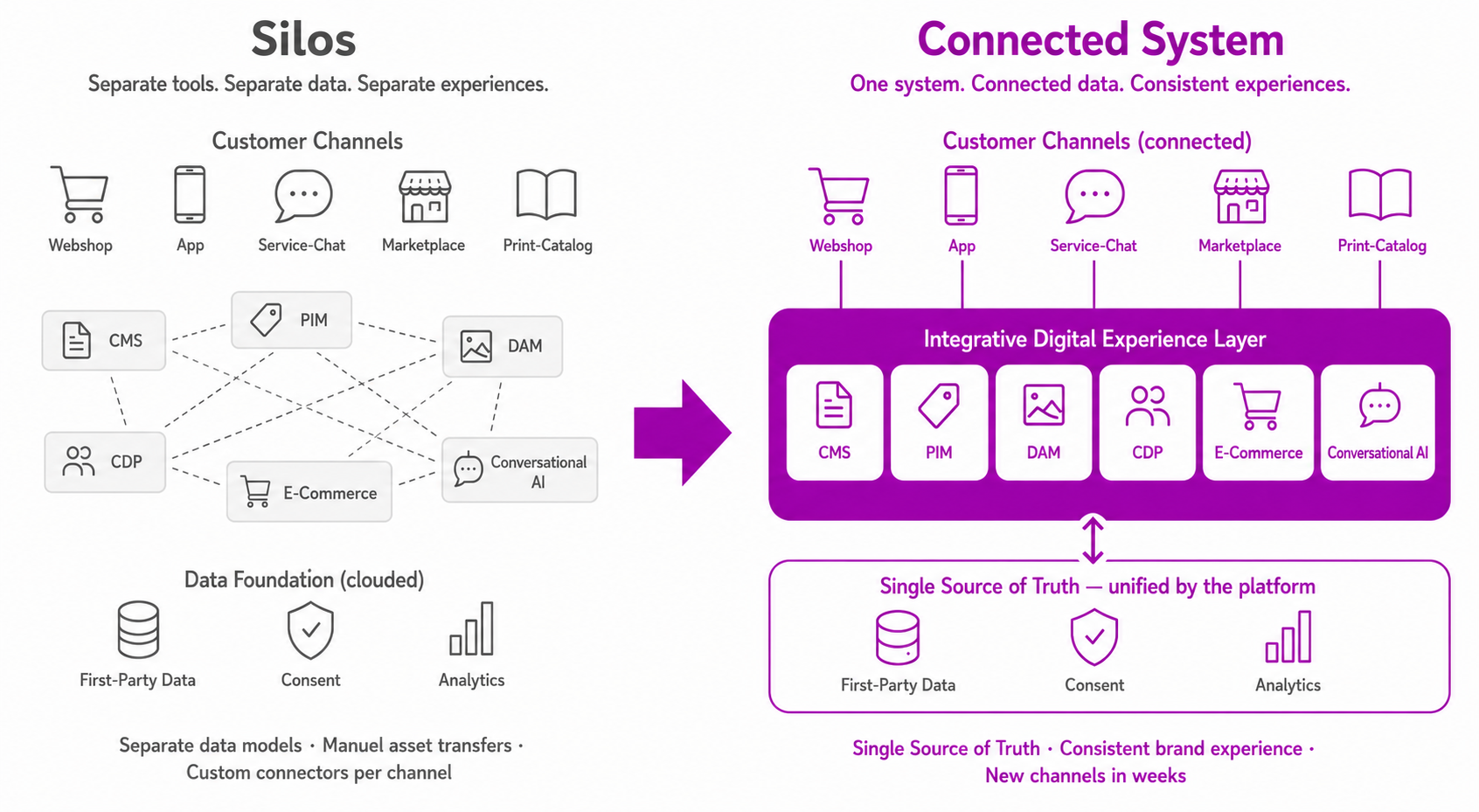
Digital Experience decides whether brands are experienced consistently, quickly, and with up-to-date data at every touchpoint — in the webshop, the service chat, the marketplace, the print catalog. When these touchpoints consist of isolated platforms that barely talk to each other, every campaign and every new feature suffers.
antegma builds setups in which content, product data, assets, commerce, and conversational AI work together as a connected system — not as parallel tool silos.
What is Digital Experience and what does it solve?
Digital Experience covers all digital touchpoints of a brand — webshop, app, service chat, marketplace, print catalog. It decides whether customers experience the brand consistently across every touchpoint, and whether new channels can be added in weeks rather than months.
The challenge: Consistency in most organizations does not fail at the individual tool, but at the bridges between tools. CMS, PIM, DAM, CDP, e-commerce, and conversational AI often run in parallel — with separate data models, separate workflows, and manual asset transfer between systems.
A Digital Experience Platform (DXP) is the answer — an integrated system that combines content (CMS), product data (PIM), digital assets (DAM), customer data (CDP), e-commerce, and conversational AI. Instead of isolated tools, you get a connected system in which every brand interaction is grounded in the same source.
Done right, it means: not a tool mix, but a coherent platform architecture — and therefore weeks rather than months for new channels, markets, and campaigns.
Digital Experience in numbers
Customers today expect every brand interaction at every touchpoint to be consistent — reality lags behind. According to the Salesforce State of the Connected Customer Report, 79% of customers expect connected, consistent interactions across all departments and touchpoints. In the PwC Customer Experience Survey 2025, 70% of executives say their customers’ expectations are growing faster than their organization’s ability to adapt. Specifically for the DACH region, the Lünendonk 2025 study on the Digital Experience Services market shows that 83% of upper-midmarket and large enterprises surveyed expect fully integrated DX engagements — from strategy and UX through data management to platform operations and continuous optimization. The global market for digital experience platforms grew to roughly USD 14 billion in 2025 and is projected to reach USD 23.5 billion by 2029 — the investment is there, but the consistency gap closes only with clean platform bridges.
Our focus areas in Digital Experience
CMS, PIM, DAM, CDP, e-commerce, and conversational AI are the core components of a Digital Experience Platform. antegma designs the architecture, selects the right platform per component, and implements them as one connected system.
Per project we combine in the right depth — depending on assortment, channel mix, and existing stack.

E-Commerce is the transaction component of a DXP — storefront, checkout, multi-market distribution. Consulting and implementation from architecture through headless setups.

CMS is the content component of a DXP — manages, orchestrates, and delivers content across all channels. CMS and DXP strategy, headless architectures, and composable setups for scalable digital experiences.

DAM is the asset component of a DXP — single source of truth for images, videos, and brand assets. Structured management, enrichment, and distribution from data model to channel integration.

PIM is the product-data component of a DXP — single source of truth for e-commerce, marketplaces, print, and customer service. Centralized maintenance, enrichment, and distribution of product data.

CDP is the customer-data component of a DXP — unifies first-party data, consent, and behavior from all touchpoints into a single source of truth for segmentation and personalization.
Conversational AI is the dialog component of a DXP — AI-powered customer service, sales, and onboarding bots. From use-case design through LLM integration to productive multi-channel rollout.
How CMS, PIM, and DAM form a DXP
Three data components that together form the data layer of a Digital Experience Platform — and feed e-commerce and conversational AI with consistent content, products, and assets.
CMS — Content
Manages copy, pages, campaigns, and localization. Delivers structured content via APIs to webshop, app, bot, print, and marketplace — one source, many channels.
PIM — Product data
Single source of truth for SKUs, attributes, variants, technical data, and translations. Feeds e-commerce, marketplaces, print catalogs, and customer service from the same data base.
DAM — Digital assets
Central library for images, videos, and brand assets with rights management and channel renditions. Delivers the right asset in the right resolution to every touchpoint.
The outcome: One brand interaction — whether webshop product page, service chat, or print catalog — is grounded in the same content, product data, assets, and customer data. That is what a Digital Experience Platform is about: not a single tool, but clean data bridges between the components — from content through products and assets to the customer data in the CDP.
How we work
Four phases in Digital Experience — from audit of existing platforms to productive operation.
1. Audit
Existing platforms, data flows, and customer journeys. Where consistency fails, which channels block growth, which data models are outdated.
2. Strategy
Which platforms, which data architecture, which workflows. With a clear migration path — no big-bang re-platforming.
3. Implementation
Platform setup, integrations, migration from legacy systems, workflow configuration.
4. Operate
Scaling across new channels, brands, or markets. Optimization, monitoring, continuous adjustment.
Why antegma as your Digital Experience advisor
15+ years of platform experience — from classic CMS and DAM through e-commerce and PIM to AI bots. From client projects in consumer goods, e-commerce, mechanical engineering, and mid-market industry.
Multi-vendor partnerships — certified with Adobe, Microsoft, Sinch, Hootsuite, Pimcore, and Canto. We recommend the platform that fits the brand reality — not the one with the highest commission.
Customer-journey-first — we start at the touchpoint, not at the tool. Platform choice follows from customer-journey requirements, not from vendor roadmaps.
Migration without big-bang — we bring existing stacks together step by step, with parallel transition and clear quality gates. No "throw everything overboard, start fresh".
Assess or consolidate your Digital Experience stack?
Bestehender Digital Experience Stack mit Plattform-Silos, geplante Migration, neuer Channel oder Conversational-AI-Erweiterung — wir sortieren in einem Erstgespräch, wo der Schwerpunkt liegt und was als nächstes Sinn macht.
You might also like

accallio SP – SharePoint Integration for Adobe Experience Manager is available now
Recently accallio SP joined our portfolio of Adobe Experience Manager integrations – called the accallio product family. Our plan is to continuously expand this platform.

Partnership with Hootsuite confirmed
antegma is happy to announce our newest partnership with the social media experts from Hootsuite. By combining antegma’s competencies with Hootsuite’s exceptional solutions, antegma will

antegma becomes an IBM Business Partner
We’re expanding our footprint for digital experience and commerce solutions and becoming an IBM Business Partner. Thanks to this new partnership, antegma will provide solutions
Frequently asked questions about Digital Experience
What is a Digital Experience Platform (DXP) and do I need one?
A Digital Experience Platform (DXP) is an integrated system of content, product data, assets, customer data, and channels — typically:
- CMS for content (copy, pages, campaigns)
- PIM for product data (SKUs, attributes, variants)
- DAM for digital assets (images, videos, brand assets)
- CDP for customer data (first-party data, consent, segments)
- E-Commerce for transactions (storefront, checkout)
- Conversational AI for dialog channels (chat, voice, bots)
You need a DXP as soon as you run more than two channels in parallel, maintain product data in multiple systems, or transfer assets manually between tools. A DXP does not have to be a single suite — it can be built from best-of-breed components, as long as the data bridges between them are clean.
What distinguishes Digital Experience from a pure website strategy?
A website is one channel — Digital Experience covers all digital touchpoints of a brand and especially how they work together: webshop, app, service chat, marketplace listings, print catalogs with product data from the PIM. Anyone with a website strategy answers the question “what does our website look like?”. Anyone with a Digital Experience strategy answers “how do we connect all digital touchpoints into a consistent brand experience — and how quickly can we add new channels without each one becoming its own custom project?”. That is the leap from a tool view to an architecture view.
Should I tackle all five focus areas at once — or sequentially?
Sequentially, with clear use-case prioritization. What is blocking growth today comes first — usually e-commerce or content management, because the customer journey there leads directly to revenue. If product data sits in fifteen Excel sheets, PIM is worth doing early; if the service helpdesk is drowning in requests, conversational AI is worth doing early. DAM typically follows once the first two focus areas are productive and brand asset consistency becomes a bottleneck. We recommend a clearly scoped use case as the first step — one that validates the architecture patterns for the next focus areas — instead of five parallel projects that block each other.
Do I need a dedicated DXP — or is a mix of best-of-breed tools enough?
Both work. An integrated DXP platform offers a shared data foundation, unified authoring experience, and built-in bridges between modules — cheaper to operate, faster for standard use cases. Best-of-breed (separate platforms for PIM, DAM, e-commerce, conversational AI) is more flexible for special requirements and usually cheaper in licensing, but more complex to integrate. The decision follows from assortment complexity, channel mix, IT maturity, and budget reality — not from vendor preferences. We assess both paths transparently per client and recommend the one that fits the brand reality.
How long does a typical Digital Experience project take?
A first productive rollout for a clearly scoped use case — for example webshop distribution for one assortment segment or a first conversational-AI bot for customer service — is live after 8 to 16 weeks. More complex setups with several focus areas in parallel, multi-market expansion, migration from legacy platforms, or deep stack integration take 6 to 12 months. Important: Digital Experience is not set-and-forget — the data model, workflows, and platform configuration need continuous care, otherwise consistency erodes faster than the platform.
How does migration from legacy platforms work without a big-bang?
Step by step, with the old platform running in parallel. The standard path: first migrate the data (products, assets, customers) and validate it in the new system, then switch one channel or touchpoint at a time — for example first the app, then the webshop, then marketplaces. The old platform stays productive until the new stack is verified for each channel. We define clear quality gates per cutover step: data quality, performance, conversion KPIs. Only when those are stable does the next channel move. That extends the migration phase by a few weeks but eliminates the big-bang risk.
Which industry experience does antegma bring?
Consumer goods, e-commerce, mechanical engineering, mid-market industry, and financial services — each focused on marketing, operations, IT, and sales processes. Methodologically, we work across industries because Digital Experience architecture in the end always combines the same building blocks. Industry-specific requirements — for example regulatory topics in financial services, EHEDG and CE compliance in packaging, or special approval workflows in B2B sales — we account for in the discovery and architecture step. We bring in the necessary industry depth without diluting platform competence.
How are GDPR and data residency handled in a multi-vendor setup?
Per platform, individual data processing agreements and EU hosting options — the larger vendors (Adobe, Microsoft, Salesforce, Sinch) offer EU data residency; smaller ones usually on request. Data flows between systems run through GDPR-compliant connectors with encryption, retention policies, and clearly documented data models. We clarify GDPR topics during onboarding with the data protection function on the client side and embed the requirements into the permission and data model. Special topics like Schrems II, third-country transfer, and audit trails are checked individually per stack combination.
How does a typical engagement start?
With an initial conversation (45 minutes) for a status assessment: current platform landscape, biggest consistency gaps, planned channel extensions, budget reality. On that basis, we recommend either a focused audit of one area (2 to 4 weeks with a concrete recommendation backlog) or a first implementation step directly, if the use-case priority is already clear. Only after the audit or first productive setup follows the decision on implementation scope and contract model. No big pitch, no 12-month roadmap on day one — we start small and scale once first results stand up.