
Adobe Workfront remains the system of record for marketing operations in 2026 — the operational truth about projects, budgets, margins, and approvals still lives there. What Adobe adds in 2026 is an AI orchestration layer on top: workspaces, projects, approval flows, and reports are configured, executed, and analyzed by agents — coordinated through the same workflows, the same permissions, and the same audit trails as before.
This post puts the extension into context, rather than repeating it as a feature list. Three questions: What’s new in 2026? What’s the deeper thesis behind it? And what does it mean operationally for marketing operations over the next twelve months?
What Adobe showed at Summit 2026
Six building blocks, with status:
- Project Catalyze (GA Q3 2026): an ideation canvas inside Workfront Planning that turns PDFs, emails, and notes into structured briefs.
- Workflow Optimization Agent (June 2026): configures workspaces, builds projects from natural-language descriptions, automates approval flows. Powered by Adobe Experience Platform Agent Orchestrator.
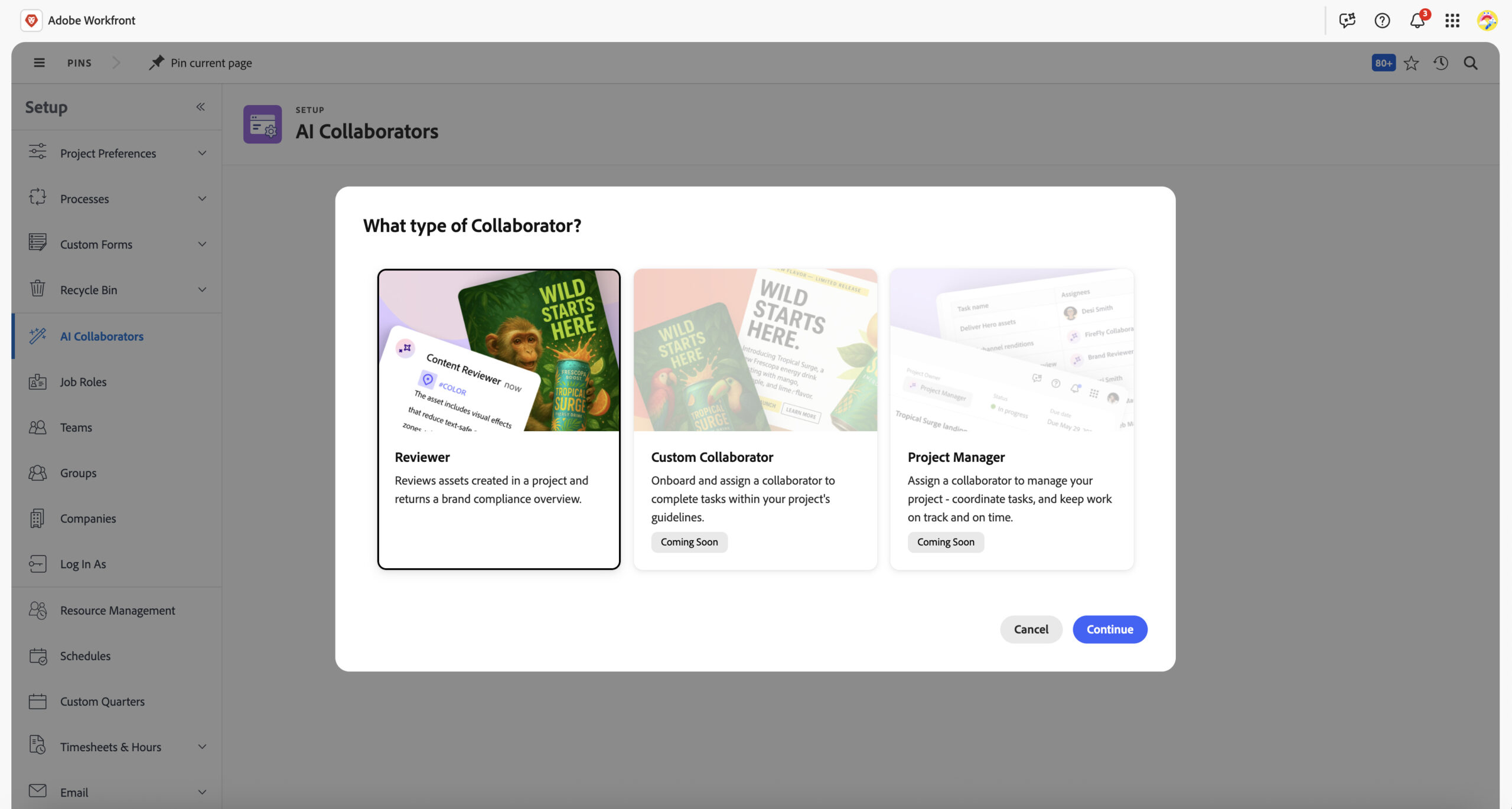
- AI Collaborators (GA Q3 2026): a framework that brings third-party agents — Microsoft Copilot Studio, Anthropic Claude for Work — into Workfront workflows as permissioned users.
- MCP server for Workfront (June 2026): Workfront becomes reachable for external agents via the Model Context Protocol.
- Standalone Workfront Planning (later in 2026): planning without the full Workflow footprint.
- Workfront-to-Workfront (Beta Q4 2026): connections for agency↔brand models.
Plus: Unified Review and Approval between Workfront and Frame.io has been GA since March 2026. AEM Content Advisor runs directly inside Workfront.
The thesis behind it
Adobe Workfront is the collaboration and context layer for the content supply chain.
Lauren Cisneros, Product Marketing Lead, Adobe Workfront
This is the claim of a layer above the system of record, where multiple actors — human, agentic, internal, agency-external — are coordinated through the SoR data as shared context. Workfront remains the single source of truth for projects, budgets, and approvals; what’s added in 2026 is an operations layer on top. Three design decisions make this concrete in practice.
Agents as a user type
In the AI Collaborators framework, third-party agents are not treated as API integrations but as permissioned identities. They get tasks assigned, their activity runs through the same audit trails, and they are reviewed via the same approval workflows.
Their first people-management experience is gonna be managing a team of agents.
Moria Fredrickson, Senior Director, Lumen
The next generation of marketing managers will learn to manage agents first, not people.
Intent instead of configuration
The Workflow Optimization Agent shifts the input mode for Workfront from structured click paths to natural-language descriptions. “Build me a workspace for the Q3 campaign with briefing, asset, and approval phases” becomes a legitimate way to operate the tool. The people who build Workfront structures no longer need to be Workfront power users.
Workfront as an MCP server
Starting June 2026, Workfront becomes reachable via the Model Context Protocol for external agents — Claude, Gemini, Microsoft Copilot, any custom-built agent. Whoever wants to talk to Workfront no longer has to write a Workfront API plugin; the protocol is standardized. This opens the platform up to a generation of agent tooling that’s being built outside Adobe.
Where Workfront sits in the Adobe Content Supply Chain
Brent Rudewick (VP Product & Strategy, Adobe GenStudio) positioned Workfront in the CSC vision session as the orchestration spine of the entire agentic content supply chain — alongside Adobe Experience Manager Assets (DAM), Firefly (generation), Adobe Brand Intelligence (compliance), and CX Analytics (measurement).
The end-to-end flow demoed live: Project Catalyze in Workfront Planning → Content Advisor surfaces approved AEM assets → Workflow Optimization Agent builds tasks and delegates to humans AND agents (Lumen’s “Copywriter Agent” in Microsoft Copilot Studio, “Sales Collateral Agent” as an Anthropic Claude Managed Agent) → Frame.io handles review with a Brand Intelligence compliance check → final assets land in AEM Assets → GenStudio for Content Marketing repurposes them for social → CX Analytics feeds performance data back into the next Catalyze brief.
In this architecture, Workfront isn’t just the tool for marketing operations. Workfront is the environment in which operations happens — including the operations agents handle. The system of record provides the context without which the agents couldn’t do anything meaningful.
What this means operationally
Operating model design, not workspace setup workshop
The question is no longer just “which boards, which workflows, which approval stages.” The question is: who has permission to instantiate agents? Who reviews agent output? How do we version agent configurations? How do we detect when an agent acts incorrectly? Workfront 2026 brings the tooling layer for these questions — the organizational structure that answers them is consulting work, not configuration work.
The data dictionary is the new first phase
We had to negotiate what the definitions of things were. Campaign means one thing to email marketers, a whole different thing to brand marketers.
Moria Fredrickson, Senior Director, Lumen
As long as Workfront fields, record types, and status models lack a consistent semantic foundation, the Workflow Optimization Agent can’t build anything meaningful — it just inherits the existing confusion. Adobe itself framed the bottleneck on stage as a stat:
80% are like, we do not have the data to really make these agents work.
Brent Rudewick, VP Product & Strategy, Adobe GenStudio
Standalone Workfront Planning shifts the entry point
Until now, Workfront was an “all-in” decision. With Workfront Planning available as a standalone product, a lighter entry becomes possible: briefing and planning structures (including Catalyze canvas and Content Advisor) without the full Workflow footprint. For organizations that want to bring in GenStudio while keeping Asana, Jira, or Smartsheet for execution, this is a new path.
Project Tailored Takes — a side note from the Sneaks
Adobe Sneaks is the entertainment slot of Summit, not the roadmap. Still: Project Tailored Takes, presented by Jordan Hall, demos an idea that connects Adobe Firefly, Workfront, Frame.io, and AEM into a continuous flow. Two years ago, a Sneak like this would have named Adobe Experience Manager as the orchestration element. In 2026, it’s Workfront.
Conclusion
Adobe is extending Workfront over the next twelve months to be both: the proven system of record stays as the data core, and on top of it emerges an AI orchestration layer that uses exactly that data as context for agents. Whoever rolls out Workfront 2026 and only implements the SoR layer is building Workfront-2024 setups. Whoever thinks both layers together is building the operations platform for an organization where agents and humans collaborate over shared data.
The most honest observation from Summit isn’t a language shift — it’s a language extension. Adobe spoke of the “system of record” in 2025. In 2026, the “collaboration and context layer” joins it. Only the combination describes what Workfront has become.
Adobe describes the Workflow Optimization Agent in its own blog post from early April 2026. For the 2025 SoR backstory, see Jaimeson Wennerstrum’s piece on the agency system of record. The Priorities UI introduction completes the picture of the 18-month trajectory.
Frequently Asked Questions
What's changing about Adobe Workfront in 2026?
Adobe Workfront remains the system of record for marketing operations in 2026. What’s added is an AI orchestration layer on top — Project Catalyze (ideation canvas, Q3 2026), Workflow Optimization Agent (June 2026), AI Collaborators (Q3 2026), and an MCP server that makes Workfront reachable to external agents like Claude or Copilot.
What is the Workflow Optimization Agent?
The Workflow Optimization Agent (June 2026 GA) configures Workfront workspaces, builds projects from natural-language descriptions, and automates approval flows. It’s powered by Adobe Experience Platform Agent Orchestrator. The goal: less manual configuration effort and faster plan-to-launch cycles for marketing teams.
What does AI Collaborators mean inside Workfront?
AI Collaborators (Q3 2026 GA) is a framework that brings third-party agents — Microsoft Copilot Studio, Anthropic Claude for Work, custom-built agents — into Adobe Workfront as permissioned users. They get tasks assigned; their activity runs through the same audit trails as that of human team members.
Does Adobe Workfront remain the system of record?
Yes. Adobe Workfront stays the central system of record for projects, budgets, margins, and approvals in 2026. The new AI orchestration layer doesn’t replace this function — it uses the SoR data as context so agents can do anything meaningful at all. Only the combination delivers the value.
When are the new Workfront AI features available?
Workflow Optimization Agent and the MCP server are available from June 2026. Project Catalyze and AI Collaborators go GA in Q3 2026. Standalone Workfront Planning ships later in 2026; Workfront-to-Workfront connections for agency↔brand models enter beta in Q4 2026. Unified Review and Approval (Workfront + Frame.io) has been GA since March 2026.
How does Workfront 2026 connect to the Adobe Content Supply Chain?
Adobe positions Workfront as the orchestration spine of the agentic content supply chain — alongside AEM Assets (DAM), Firefly (generation), Brand Intelligence (compliance), and CX Analytics (measurement). Tasks from Workfront delegate to humans or agents; outputs land in AEM Assets; performance data flows back via CX Analytics into the next brief.