
Adobe Summit 2026 put Adobe CX Enterprise and three brand layers at center stage. Less discussed but decisive for Adobe-stack customers over the next twelve months: the architecture of the Content Supply Chain that has to carry those coworkers and agents in the first place.
antegma has been rolling out Content-Supply-Chain solutions at marketing organizations for years — as an operating model, not as a tool stack. Adobe is now articulating this view in the open for the first time. In the session Transforming your Content Supply Chain for the AI World, Brent Rudewick (VP Product and Strategy for Adobe GenStudio) delivered a clear framework. With one uncomfortable number: 80 % of respondents in Adobe’s research name missing data as the biggest obstacle to Agentic AI. The tools aren’t the problem. The foundation underneath is.
More than half feel ready — but 80 % lack the data
A live poll in the Adobe session surfaced a familiar picture: who feels ready to deploy Agentic AI to scale content? More than half of the audience raised their hand. Then came this from Adobe:
And I will tell you, that 80%! 80% are like, we do not have the data to really make these agents work.
Brent Rudewick, VP Product & Strategy, Adobe GenStudio
That’s the fault line many Agentic AI discussions skip today. Marketing teams have tools — and assume that’s the same as having a foundation. Adobe’s sober correction:
In a marketing conference, data isn't sexy. But in the world of AI, it's going to become the sexiest thing that you have, because without it, you will not get the value.
Brent Rudewick, VP Product & Strategy, Adobe GenStudio
We see the same in our engagements. Adobe customers with mature GenStudio setups run agent POCs that shine in the demo and stall in operations — because briefs, approval history, asset metadata, and campaign definitions sit in five separate systems, and no agent can build a consistent picture from them.
Three Maturity Stages of an Agentic Content Supply Chain
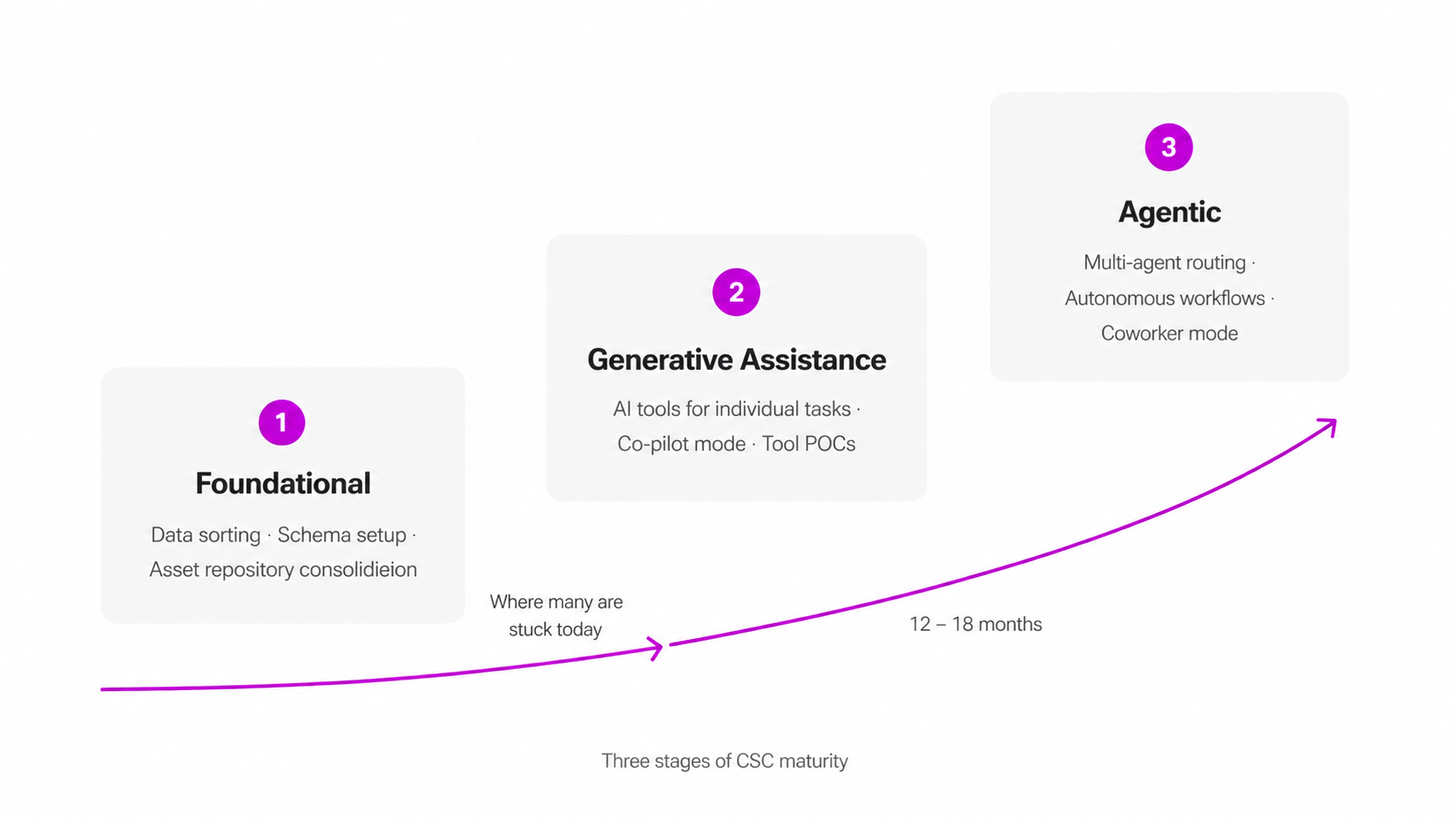
Adobe’s maturity curve has three stages — with a clear sense of where brands typically stand today:
Stage 1 — Foundational. Workfront and AEM Assets are integrated, content performance is measured. Humans click, AI is not yet in an operational role. This is where most customers stand today.
Stage 2 — Generative Assistance. AI suggests variants, accelerates brand checks. Marketing teams stay in control, AI takes over the micro-work.
Stage 3 — Agentic Content Supply Chain. Agents own entire workflow stretches autonomously — workspace setup, approval coordination, reporting, variant generation. Humans stay in the loop for strategy and governance, not for the mechanics anymore.
Important: every stage delivers value. No “all or nothing.” But the stage-3 levers — new speed and scale — only work when the data and schema foundation underneath is in place.
Pillar 1 — Enterprise Context
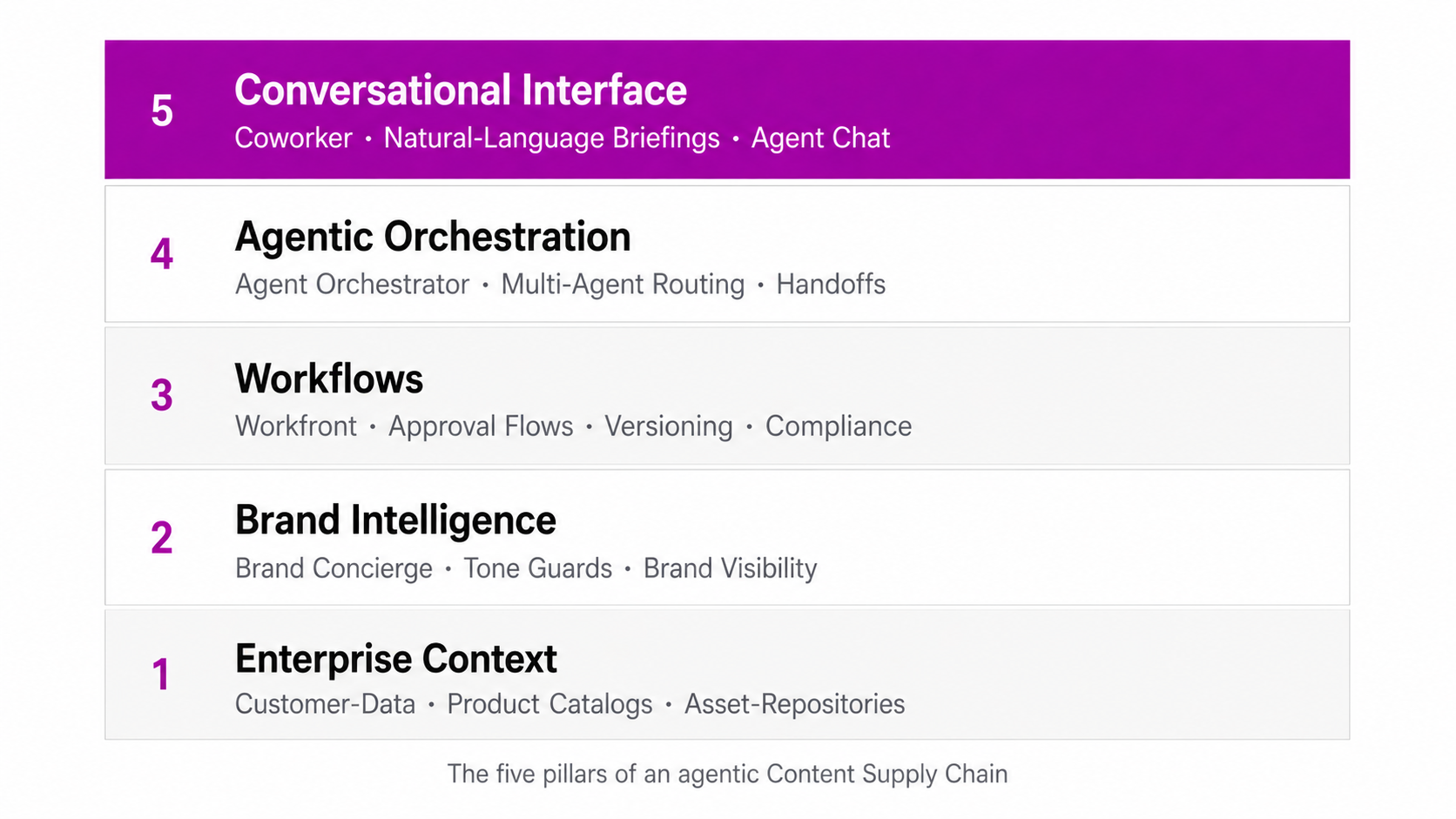
The first of the five pillars is the least attractive — and the most consequential: a consistent data layer of briefs, approved content, decision history, asset metadata, and a unified schema definition for terms like “campaign.” A pointed question from the session:
How many folks have solved the definition of a campaign in your organization?
Brent Rudewick, VP Product & Strategy, Adobe GenStudio
— barely any hands go up.
It sounds academic. It isn’t. When an email marketer defines “campaign” differently than a brand marketer, an agent can’t make consistent decisions on top of that. The result: output quality breaks down as soon as the use case gets more complex than the POC.
Customer evidence: Prudential reports 135 % higher engagement rates with personalized AI content — because asset storage and metadata structure work together consistently. The generation engine can rely on that as a foundation.
Pillar 2 — Brand Intelligence
The core of this pillar I sketched in the first recap: Adobe Brand Intelligence replaces the static brand-guideline PDF with a learning reasoning layer that has three skills — Validate, Instruct, Predict. Validate checks output against current brand reality. Instruct trains generative engines on voice and tone. Predict flags which variants will create brand risk before they’re published.
In the Content-Supply-Chain architecture, Brand Intelligence sits across all workflows: every AI-generated variant passes through the brand filter, without a human brand police having to manually check every output. Brand work shifts from documentation to curation.
Pillar 3 — Workflows
Workfront becomes the workflow backbone of the agentic Content Supply Chain in Adobe’s roadmap. The most important change: tasks can no longer only be assigned to humans — agents take them too. Add Firefly for Creative Production and a new GenStudio module for Content Marketing (long-form).
The most concrete tool from this pillar is the Workflow Optimization Agent, which Adobe announced on April 20, 2026. Julie Johnson, Product Marketing Lead at Workfront, puts the diagnosis more sharply in the blog post than she did from the stage:
Modern work management often breaks down not because teams lack tools, but because the cost of setup is too high.
Julie Johnson, Product Marketing Lead, Adobe Workfront
Approval velocity is rarely limited by decision-making — it is limited by coordination overhead.
Julie Johnson, Product Marketing Lead, Adobe Workfront
The agent translates natural language into structured workspaces, creates projects with templates, priorities, budgets, and task dependencies, builds approval workflows from a single prompt, and delivers approved assets directly to AEM. Plus: marketing teams can query work data in natural language instead of waiting for reports.
Customer evidence: Vanguard reports 90 % targeted savings in content production through GenStudio-driven workflows.
The takeaway for Adobe customers: anyone running Workfront today who moves into agent-coworker mode over the next months isn’t building on greenfield. The existing Workfront investment becomes the foundation — provided the workspaces are cleanly structured.
Pillar 4 — Agentic Orchestration
This is the strategic thrust of Adobe’s roadmap. Four concrete agents start the lineup:
- Strategic Ideation Agent in Workfront Planning — from campaign idea to roadmap
- Workflow Optimization Agent (see Pillar 3)
- Content Production Agent — orchestrates capabilities across GenStudio
- Content Advisor Agent — already available, now with broader reasoning
What Adobe positions unusually openly here: the Agent Orchestrator is built for interoperability with AWS, Anthropic, Google Cloud, Microsoft, NVIDIA, and OpenAI. Third-party agents — Claude, OpenAI, Copilot, custom agents — are deliberately brought into the Adobe ecosystem. Agentic marketing won’t live in a walled garden. This matches what we see at customers: hybrid agent stacks are the reality, not the exception.
Pillar 5 — Conversational Interface
The fifth pillar is the thinnest in Adobe’s architecture but decides adoption. Conversational UIs become the primary interface for agents. The key design decision: Adobe brings agents into the tools marketing teams already work in — Workfront, AEM, GenStudio — instead of forcing a new central console. Meet people where they are.
“It’s not a tool, it’s an operating model”
The sharpest line of the session came from the customer side. Lumen has been in this transformation for almost two years — and Brand Director Moria Fredrickson’s diagnosis is clearer than any roadmap slide:
It is not a tool. It is an operating model for your team. It is an evolution of your organization. It is a behavior change.
Moria Fredrickson, Brand Director, Lumen
Lumen’s transformation ran through four phases — data, experiences, teams, technology. The copywriters’ first reaction was fear: “Am I being replaced right now?” Today the same people are content strategists who work with brand-voice coaches and research agents and produce more depth than they could ever assemble manually.
Lumen’s outcomes after roughly two years: 70 hours less concept time per core campaign, five million dollars less in paid-media production costs in a single year, 15× content scaling at 65 % higher speed — on a flat budget with unchanged team size.
Start small, stay focused
Against the temptation to switch on all agents at once, the most important advice from the session for Adobe-stack customers comes — again — from the customer side:
Start small. Pick a channel. Pick a single campaign. Pick a certain part of your content supply chain and focus there. It's hard to do the whole thing at once.
Moria Fredrickson, Brand Director, Lumen
The data dictionary was the hardest part of Lumen’s transformation, not the tools. The biggest takeaway: AI roadmap and data roadmap can’t be decoupled — the use case is only as good as the data behind it.
antegma’s Content-Supply-Chain Framework Aligns with the Five Pillars
We’ve been deploying our Content-Supply-Chain operating-model framework at marketing organizations for years — and the picture from the Adobe session matches our consulting experience one-for-one: tool POCs without a solid operating model reliably stall at stage 2. Brands that sort schemas, asset repositories, and approval ownership first — before they switch on agents — reach stage 3 in 12 to 18 months. Everyone else spends the same time in POC hell.
Adobe now delivers the infrastructure with the Agent Orchestrator and the four agents — the question for marketing leaders is not which tools to buy, but which data foundation, schemas, and team structures hold up when those tools go live. That’s exactly what our framework addresses: operating-model setup before tool rollout, data schema before agent POC, team roles before workflow automation.
Practical Outlook
Anyone working in the Adobe stack today and planning to move into agentic mode in the next months should run two tracks in parallel: sharpen the operating model — schemas, asset structures, approval ownership — and pick a clearly bounded pilot channel where the first agents go into production. That’s exactly what we deliver with our Content-Supply-Chain framework: architecture, data foundation, team setup, and pilot rollout along a proven methodology.
If you want to evaluate concretely where your Content Supply Chain stands today and where the fastest lever for agent activation lies — get in touch directly. We share our perspective without waiting for the next roadmap slide.
More on antegma’s Content-Supply-Chain framework: Content Supply Chain Consulting & Implementation.
Frequently Asked Questions
What is an agentic Content Supply Chain?
An agentic Content Supply Chain is an operating model in which AI agents — orchestrated through a central platform like Adobe Agent Orchestrator — autonomously take over tasks across the marketing content lifecycle: interpreting briefs, generating variants, validating brand compliance, steering approval workflows, and coordinating distribution. Humans stay responsible for strategy, governance, and edge cases.
What are the five pillars of an agentic Content Supply Chain?
Adobe positions five interdependent pillars at Summit 2026: 1. Enterprise Context (data foundation), 2. Brand Intelligence (brand validation), 3. Workflows (Workfront as backbone), 4. Agentic Orchestration (agent routing through Adobe Agent Orchestrator), 5. Conversational Interface (Coworker, natural-language briefings). Pillar 5 only works when Pillar 1 — the data foundation — is in place.
What are the maturity stages of the Content Supply Chain?
Three stages: Foundational (data sorting, schema setup, asset repository consolidation), Generative Assistance (AI tools for individual tasks, co-pilot mode, tool POCs), and Agentic (multi-agent routing, autonomous workflows, coworker mode). Most brands sit between stages 1 and 2; the jump to stage 3 typically takes 12 to 18 months.
Why do agentic AI POCs fail on the data foundation?
80 % of brands surveyed by Adobe name missing data as the biggest obstacle to Agentic AI. When briefs, approval history, asset metadata, and campaign definitions sit in five separate systems, no agent can build a consistent picture. POCs shine in the demo and stall in operations as soon as the use case gets more complex.
What does “operating model, not tools” mean?
Lumen puts it like this: “It is not a tool. It is an operating model for your team. It is an evolution of your organization.” Tools alone don’t produce an agentic Content Supply Chain — the transformation covers data, experiences, teams, and technology. Without operating-model setup before tool rollout, brands reliably stall at stage 2.
How does antegma support brands in building an agentic Content Supply Chain?
antegma has been rolling out Content-Supply-Chain solutions at marketing organizations for years — as an operating model, not as a tool stack. We start with architecture and data foundation, sharpen schemas and approval ownership, pick a pilot channel, and roll out agents along a proven methodology. More on Content-Supply-Chain consulting.