
A content supply chain connects planning, production, delivery and reporting into one continuous chain. The building blocks are already in place at most marketing organizations: work management, a DAM, a CMS, analytics. What is missing is the decision about which block leads which task, and who decides.
That decision drives cycle times, reuse, and whether an additional channel also needs additional headcount.
We support you from the stocktake through the operating model to implementation and running operations.
What is a content supply chain?
A content supply chain reaches from the request for a piece of content through to its effect, and it includes the management of every asset created along the way. The term comes from logistics, and the analogy holds further than it first appears. It is about cycle times, inventory, bottlenecks and reuse. An asset nobody can find costs as much as stock nobody knows about.
The difference to content strategy lies in the question. Strategy answers which content should be created. The supply chain answers how the organization delivers it.
How a content supply chain is built
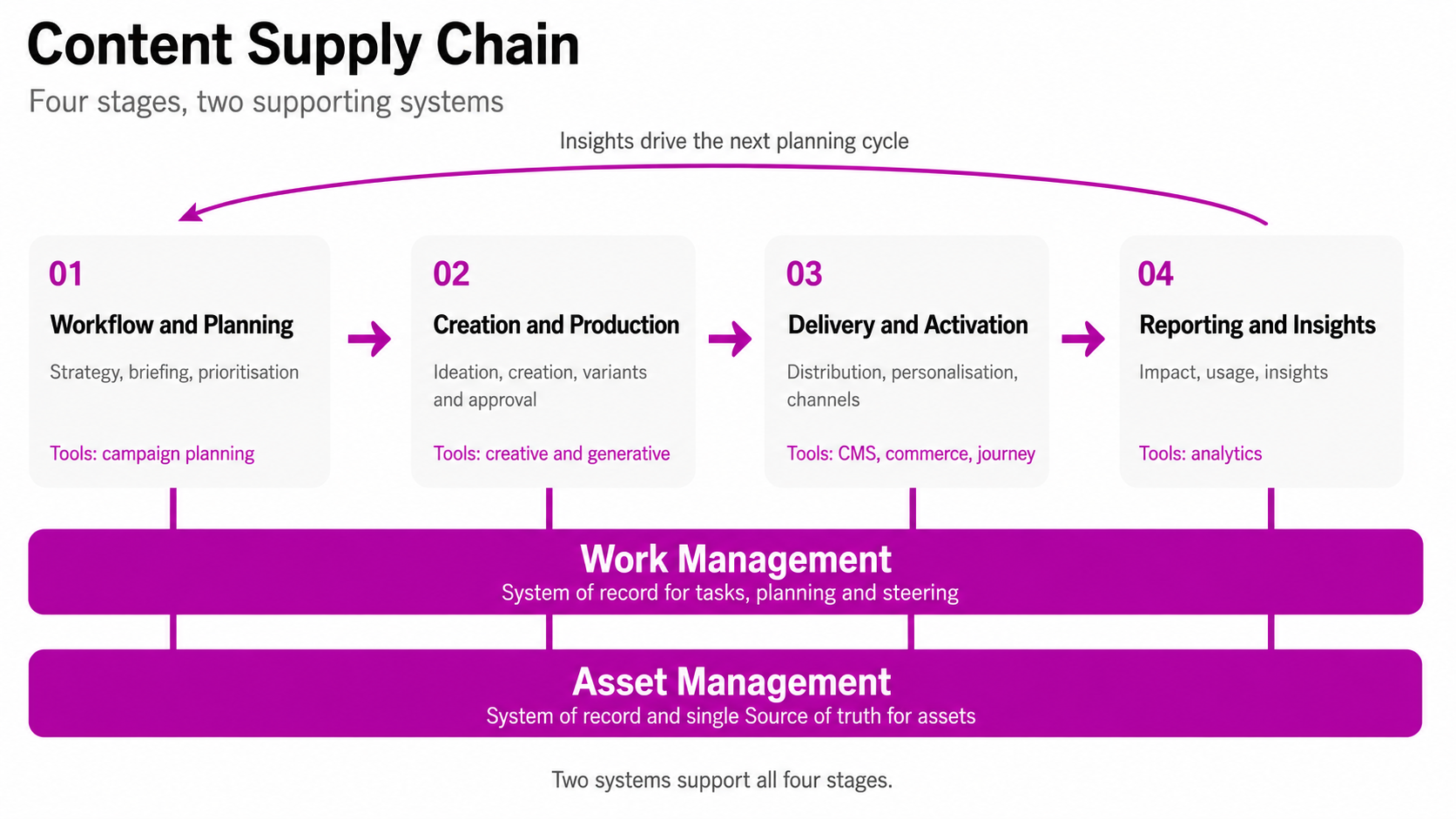
Every stage needs a named role, a defined process and a leading system. If one of the three is missing, the work shifts into the next stage and surfaces there as a capacity problem.
Workflow and planning
Turning data and insight into a strategy, then into a brief and a project plan. This is also where it is decided which content has to go through an approval chain and which runs against a template.
Creation and production
People and machines work together, not one after the other. People make the decisions, machines handle the volume. Where exactly the line runs depends on the use case.
Delivery and activation
Publishing into website, shop, campaign systems and social channels, personalized by audience and context. Only approved assets go into this stage.
Reporting and insights
What worked, which assets were used, what was left sitting. Unused production is the most expensive item in the chain, and it shows up in no report that only measures reach.
Two systems carry all four stages
Four stages need two systems that belong to none of them.
Work management is the system of record for tasks, campaign planning and steering. Brief, deadline, capacity and status live there, from the first request through to evaluation.
The DAM is the system of record and single source of truth for assets. It is needed before production, when checking whether something suitable already exists. After approval, for rights and expiry dates. And at every publication, when a channel references an asset.
Which role does what across these stages, who approves and which system leads, is described by the content supply chain operating model.
These are the problems a content supply chain solves
Five patterns we meet again and again in marketing organizations. None of them is solved by more capacity.
Deadlines are promised before capacity is checked
Without a planning stage every request is accepted. Prioritization happens later, under time pressure, and usually in favour of the loudest voice.
With a planning stage you commit to what capacity can carry. The date then holds, because it was checked against the workload first.
Every campaign starts from scratch
Existing assets are not found, so they are produced again. The effort shows up as production cost and not as what it is: a findability problem.
Once assets are findable, production effort falls without publishing less. The next campaign then starts from what already exists.
Approvals without deadlines
The longest stretch in a piece of content’s life is rarely production. It is waiting. An approval chain without agreed deadlines is a queue with names on it.
With named stations and agreed deadlines the open-ended waiting ends. Whoever does not respond either agrees or the item escalates.
The same asset in several versions
Where a connection between two systems is missing, people copy. From that moment the same content exists more than once, and at the first change nobody knows which version holds.
When channels reference the original instead of copying it, variants for formats and markets come out of that one source. Effort then no longer grows at the same rate with every additional channel.
The campaign gets evaluated instead of the asset
Performance data usually exists, just not on the asset. Which version worked and which was never used cannot be read from it. Production continues regardless.
Only once data and asset are linked does effect become visible per piece. The next round of planning then decides on what actually worked.
Do the stocktake yourself
If you recognize at least one of these patterns, you can take the next step without us.
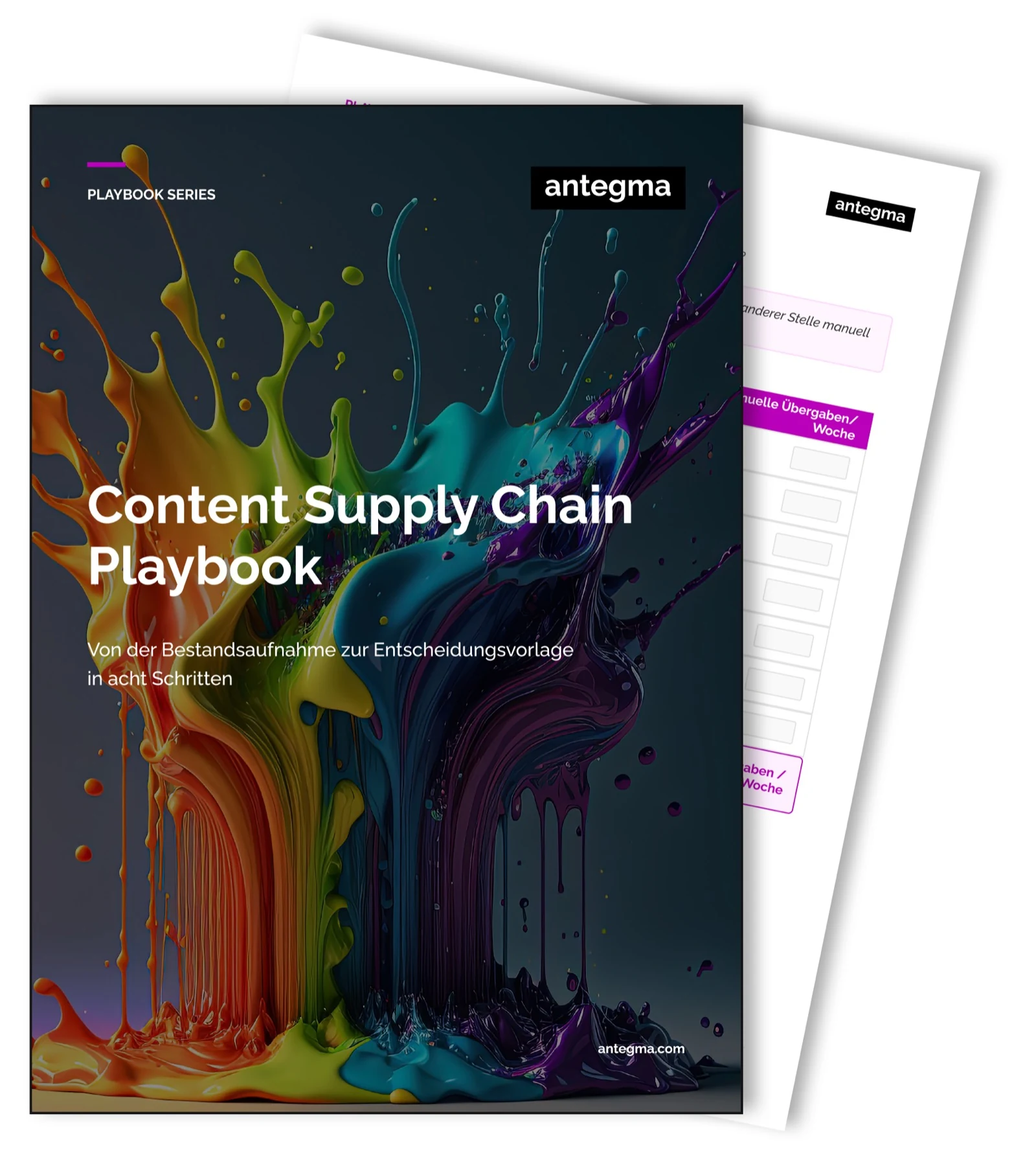
The Content Supply Chain Playbook walks you through the stocktake in nine steps: staff the roles, trace the actual path a piece of content takes, cut the approval chain, define one leading system per stage and count the manual handoffs. To print and fill in, half a day with the right people in the room.
At the end you have one page for your leadership meeting.
Our services
From the stocktake through to running operations. Which building blocks a project needs follows from the findings, not from a standard package.
Strategy and roadmap
Target picture, measures and a staged roadmap with an effort estimate per stage. That is what makes it possible to decide what comes first and what can wait.
Processes and operating model
Recording how work runs today, a process map, and a draft operating model with roles, approval paths and platform assignments.
Implementation
Setting up the platforms, configuring the processes, migrating from existing systems. At the end there is a working state with an operations manual and a handover, so your team can carry on without us.
Integration and development
The connections between systems, including where no off-the-shelf product exists. Built so that an update on one side does not take the other down with it.
Change management
An operating model only takes effect once people work to it. We train power users on a train-the-trainer basis, and they pass the approach on themselves. Plus an operations manual and communication that names the gain for each role, not only the benefit to the company.
Reporting and business intelligence
Reporting that carries decisions. Cycle times, reuse and asset usage, not just reach.
If capacity is what jams first: the production process can be ordered independently of everything else. What that means is described on the page about automated content production. You do not need the whole chain to solve the capacity problem.

Do the stocktake with us
If the stocktake has to hold up, we take it on.
The content supply chain audit starts with six to ten interviews, and only then comes the workshop. That way the room works from the recorded process, not from assumptions. After six weeks six documents are on the table: target picture and measures, process map, draft operating model, technology map, a roadmap with an effort estimate per stage, and the closing presentation.
Fixed scope, fixed duration, named result.
Platforms for the content supply chain
One leading system per stage. Which products those are depends on the landscape you already have, and in many cases it is already enough.
Work Management
System of record for tasks, campaign planning and steering. Adobe Workfront or monday.com.
Digital Asset Management
Single source of truth for assets, with metadata, rights and renditions per channel. Adobe Experience Manager Assets or Canto.
Production
Creative tools for the core material, generative production for the variants. Adobe Creative Cloud, Firefly and GenStudio.
Delivery and evaluation
CMS, commerce and journey systems deliver, analytics measures the effect. Adobe Experience Manager Sites, Adobe Commerce, Journey Optimizer and Customer Journey Analytics.
Two routes lead to a content supply chain that holds. Either every stage is filled by the product that fits it best and the handovers are built as connections. Or one ecosystem covers several stages and brings the handovers with it.
Both work. The first route gives more freedom in the selection, the second saves integration effort. The second is most fully built out at Adobe, where all four stages come from one vendor. For paid channels, Adobe GenStudio for Performance Marketing additionally brings them together in a single product.
The content supply chain in five industries
The same content supply chain, different triggers. In these five industries the task becomes visible earlier than elsewhere, because something is added on top.

Banking and insurance
When a rate changes, every asset that shows it is wrong in the same moment.

Retail and consumer goods
The assortment sets the pace, and the marketplaces set the formats.

Pharma and medical technology
The reader decides what the content may say. Approval sets the ceiling.

Industry and mechanical engineering
The content has to last as long as the machine, and from 2027 by regulation too.

Publishers and media companies
Here the content is the product. Production scales, rights clearance does not.
These five are examples, not a selection. Anyone who recognizes their own organization in one of these descriptions is working on the same task, even without being in the same industry.
Why antegma
We build content supply chains in enterprise environments, from the stocktake through the operating model into running operations.
We build connections between systems even where no off-the-shelf product exists, and we run them afterwards ourselves.
Vendor-neutral on platform choice. We also say so when what you already have is enough and only the assignment is missing.
Rollout in stages along a roadmap, with change management per phase, not as a cut-over on a single date.
Where does your content production jam?
Describe briefly how content is created at your organization today and where it gets stuck. We will come back to you with a proposed time for a first conversation. There we go through your starting position, your open questions and which next step fits.
The dependable reading, with a target picture and a roadmap, comes from the Content Supply Chain Audit.
Free of charge and without obligation.
You might also find this interesting

accallio SP – SharePoint Integration for Adobe Experience Manager is available now
Recently accallio SP joined our portfolio of Adobe Experience Manager integrations – called the accallio product family. Our plan is to continuously expand this platform.

Partnership with Hootsuite confirmed
antegma is happy to announce our newest partnership with the social media experts from Hootsuite. By combining antegma’s competencies with Hootsuite’s exceptional solutions, antegma will

antegma becomes an IBM Business Partner
We’re expanding our footprint for digital experience and commerce solutions and becoming an IBM Business Partner. Thanks to this new partnership, antegma will provide solutions
Frequently asked questions about the content supply chain
What is a content supply chain?
A content supply chain is the chain from the request for a piece of content through to its effect. Four stages interlock: planning, production, delivery and evaluation. The management of every asset carries them as a backbone. The last stage leads back to the first, because the insights steer the next round of planning.
What is the difference between a content supply chain and content strategy?
Content strategy answers which content should be created for which audience, and why. The content supply chain answers how the organization delivers it: with which roles, in which process and across which systems. A strategy without a working supply chain stays a plan nobody can execute.
What does a content supply chain consist of?
Of four consecutive stages and two systems that carry all four. The stages are workflow and planning, creation and production, delivery and activation, and reporting and insights. The two supporting systems are work management as the system of record for tasks, planning and steering, and the DAM as the system of record and single source of truth for assets. The last stage leads back to the first, because the insights steer the next round of planning.
Does a content supply chain have to be built in all stages at once?
No. A project takes on the stage where the company sees the biggest lever and leaves the others as they are for now. There is one dependency: scaled production and reliable delivery assume orderly asset management. If nothing is settled there, the other stages only amplify the existing mess.
Does a content supply chain need new software?
Often not. In many organizations work management, DAM, CMS and analytics are already in place, but it is not defined which system leads which task. That is exactly what produces duplicate stores and contradictory states. Where there really is a gap we say so, and we also say so when what you already have is enough.
How does building a content supply chain start?
With a stocktake. How content is really created today, where it gets stuck, which systems are in use and where functions are licensed twice. That is what shows which stage comes first. The Content Supply Chain Audit delivers exactly that in six weeks, with a target picture, process map, draft operating model and a staged roadmap.