
monday service is the service desk and ticketing solution of the monday platform — for IT support, internal service (HR, facility, procurement), and external customer support. As a certified monday.com partner, we help service organizations select, set up, integrate, and migrate to monday service.
This page gives you the overview: what monday service does, in which service use cases it delivers the most leverage, which services we offer around the product, and which service areas it’s suitable for.
monday service is part of the monday.com platform — you can combine it cross-functionally with monday work management, monday CRM, monday dev, and monday campaigns — for example, for seamless escalations from the service desk into engineering or account management.
What is monday service?
monday service is the specialized service desk and ticketing application of the monday.com platform. Service teams manage tickets, requests, SLAs, and knowledge base articles in flexible, board-based structures — without rigid ITSM schemas, but with full adaptability to your own service process.
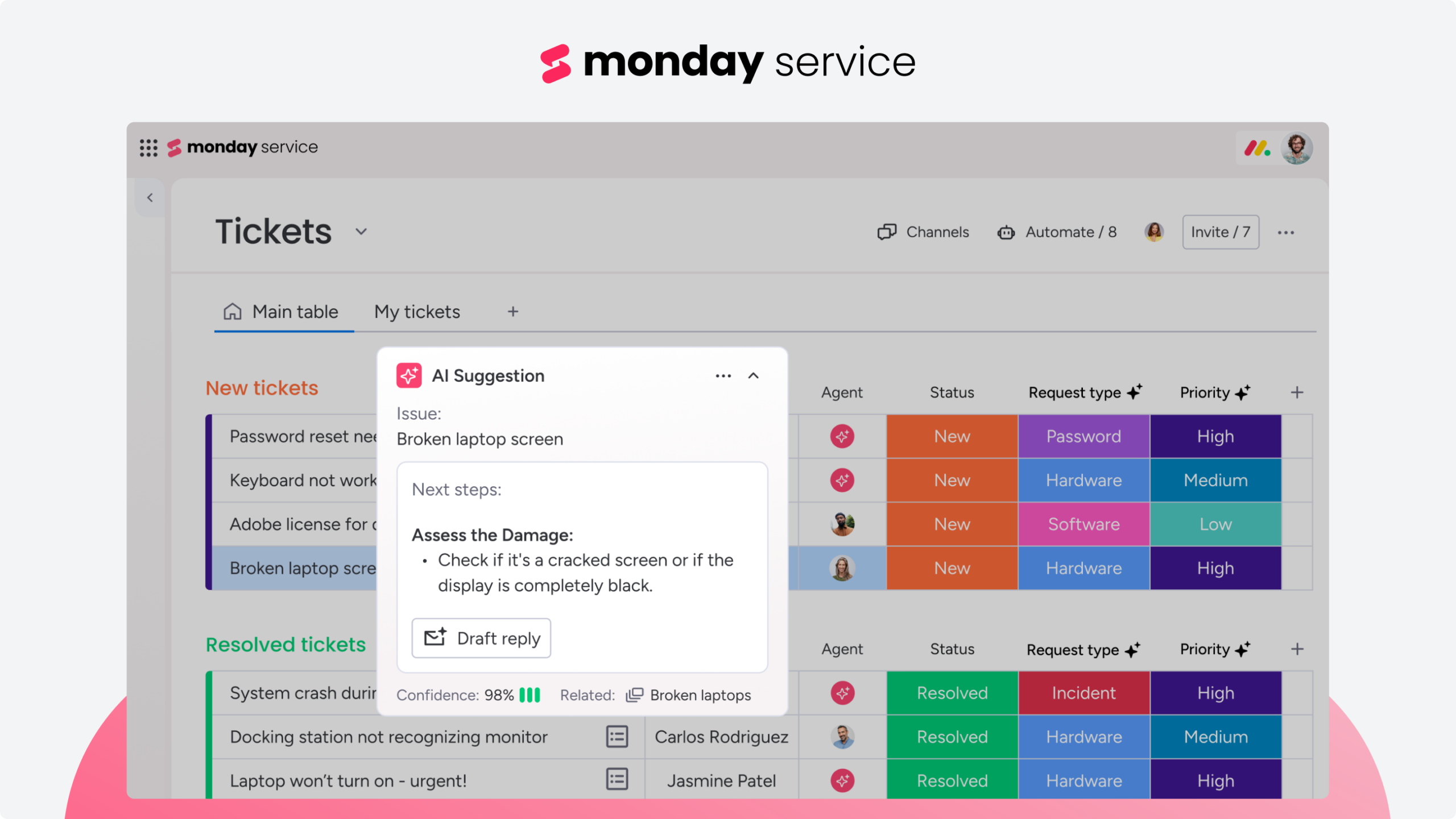
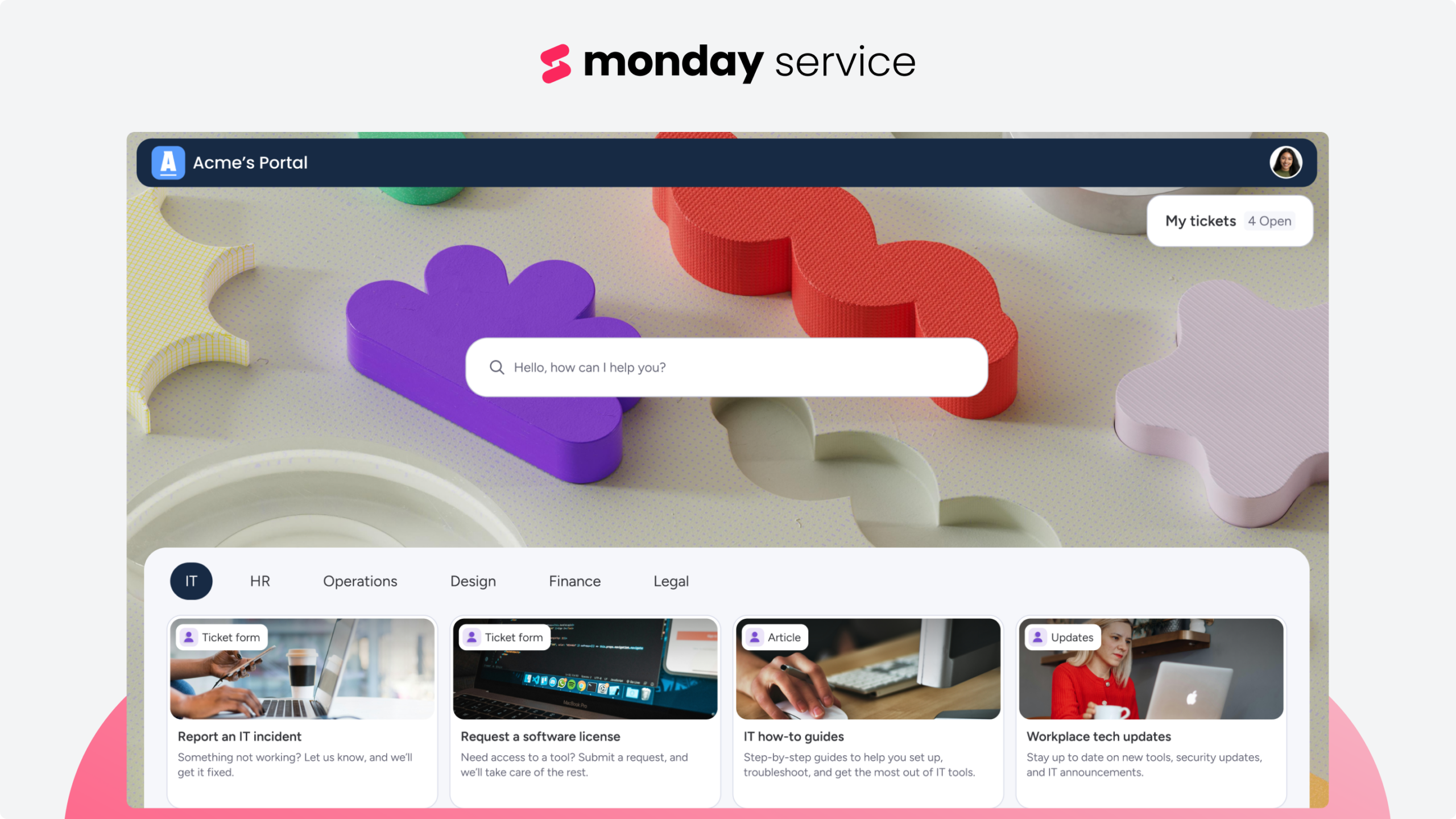
Add to that multi-channel intake (email, web form, portal, chat integration), automated classification and routing, SLA tracking with escalation logic, self-service portals for end users, AI-supported reply suggestions, and an integrated customer portal. Through native integrations and the monday API, monday service connects to Microsoft 365, Slack, Salesforce, Jira, and common identity providers.
Compared to classic helpdesk solutions like Zendesk, Jira Service Management, or Freshdesk, monday service is significantly more flexible in workflow and data model adaptation — particularly strong in cross-functional service scenarios (IT + HR + Facility on a single platform instead of multiple specialized tools). Zendesk remains stronger when pure customer-support volume with omnichannel depth is the priority; Jira Service Management for engineering-centric ITSM scenarios with ITIL depth.
Where monday service delivers the most leverage
Across our projects, six application areas stand out where monday service delivers value particularly fast:
- IT service desk. Classic incident, request, and change management for internal IT teams — with SLA tracking, prioritization, escalation, and reporting for IT leadership.
- Cross-functional internal service. HR, facility, procurement, or legal requests are bundled in a shared service layer — employees have a single access point, service teams each work in their own boards.
- External customer support. Customer support tickets with multi-channel intake, knowledge base linking, SLA reporting, and automated escalation to account management or engineering.
- Service request and approval workflows. Standardized service requests (hardware orders, access rights, onboarding) with automated approval loops and hand-off to implementation teams.
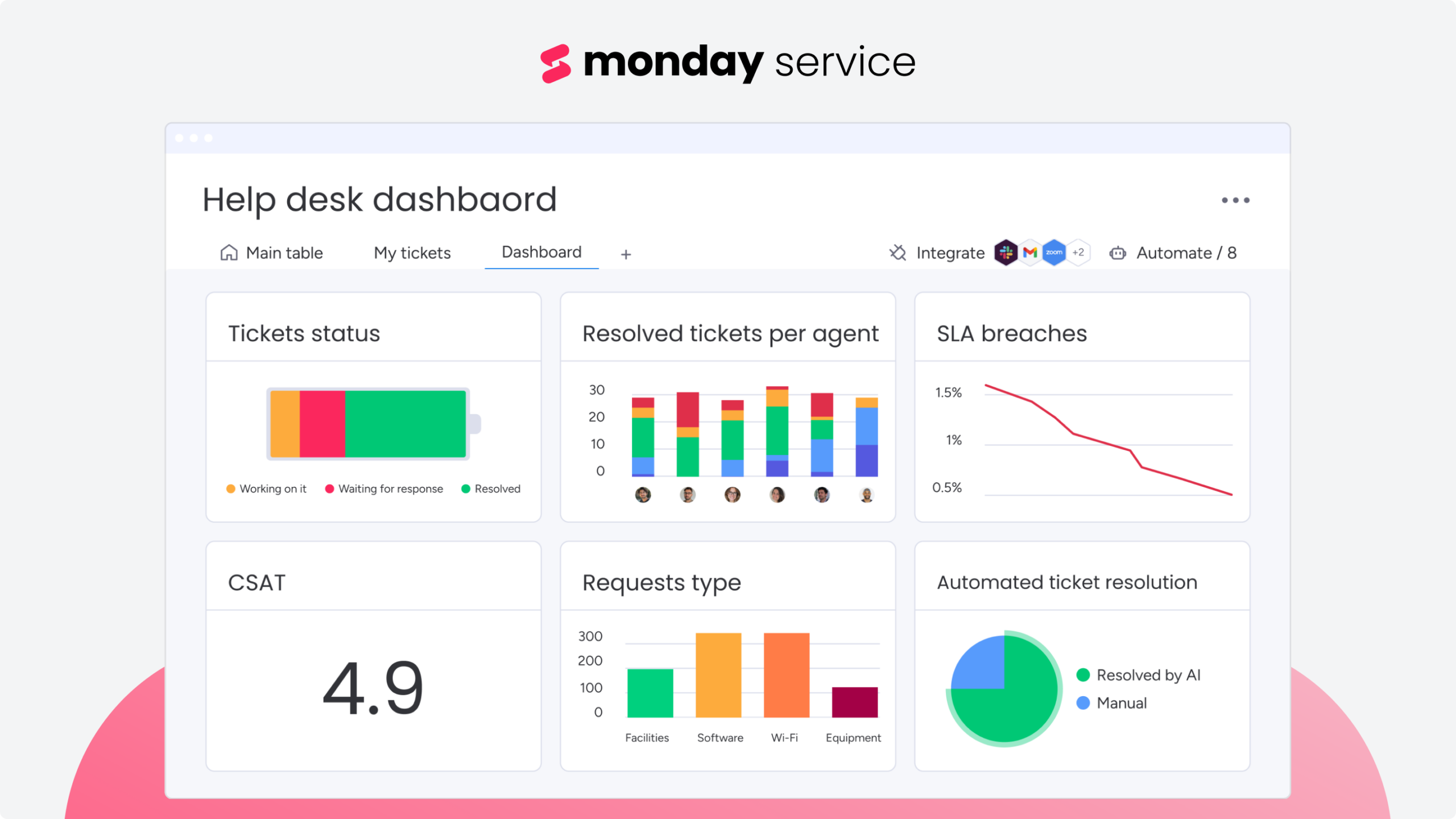
- SLA tracking and reporting. Real-time dashboards for service leadership: first-response time, resolution time, SLA compliance, backlog trends, top volume sources.
- Cross-product escalation. Tickets the service team can’t solve alone are passed directly into monday dev as a bug, into monday work management as a project task, or into monday CRM as an account escalation — without switching tools.
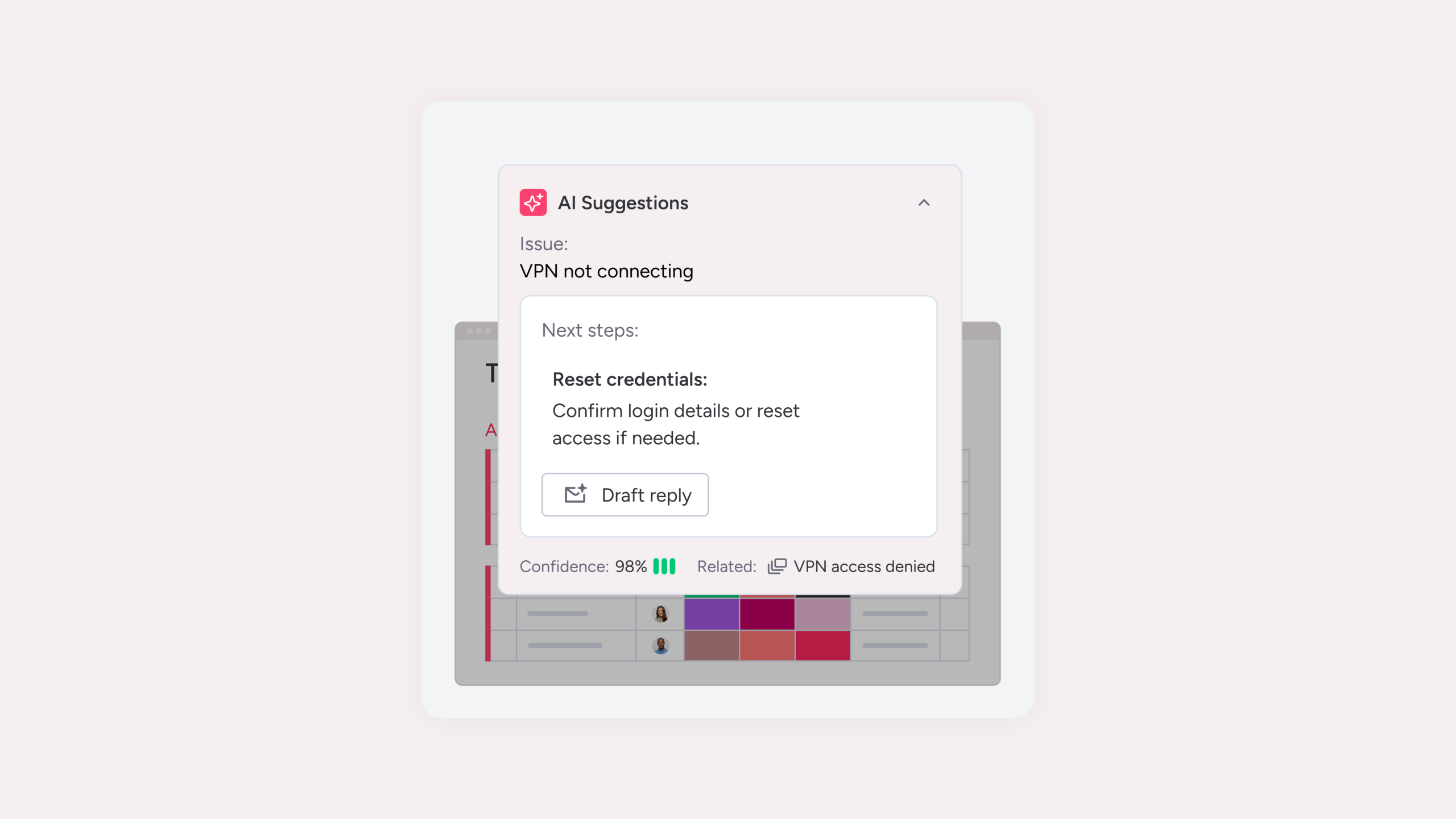
- AI classification and reply suggestions for tickets. With monday AI, tickets are automatically categorized and routed; for standard requests, AI proposes complete draft replies. First-response time drops significantly.
Each of these use cases can be implemented as a standalone first release — without rebuilding the entire service tool landscape.
Functions and features
monday service combines classic service-desk functionality with the flexibility and cross-functionality of the monday.com platform. The most important capability areas:
Ticketing and intake
- Multi-channel intake — email-to-ticket, web forms, self-service portal, native Slack and Microsoft Teams integration, optional chat integration.
- Customizable ticket structures — any fields and status models per service area.
- Automatic classification and routing — rule-based assignment to teams, skill-based routing, round-robin, or load balancing.
SLA management
- SLA definitions — first-response and resolution targets per priority, service area, or customer tier.
- Escalation logic — automatic notifications, re-assignment, or escalation tickets when SLA breach is imminent.
- SLA reporting — dashboards for compliance rates, trend analyses, and hot-spot detection.
Self-service and knowledge base
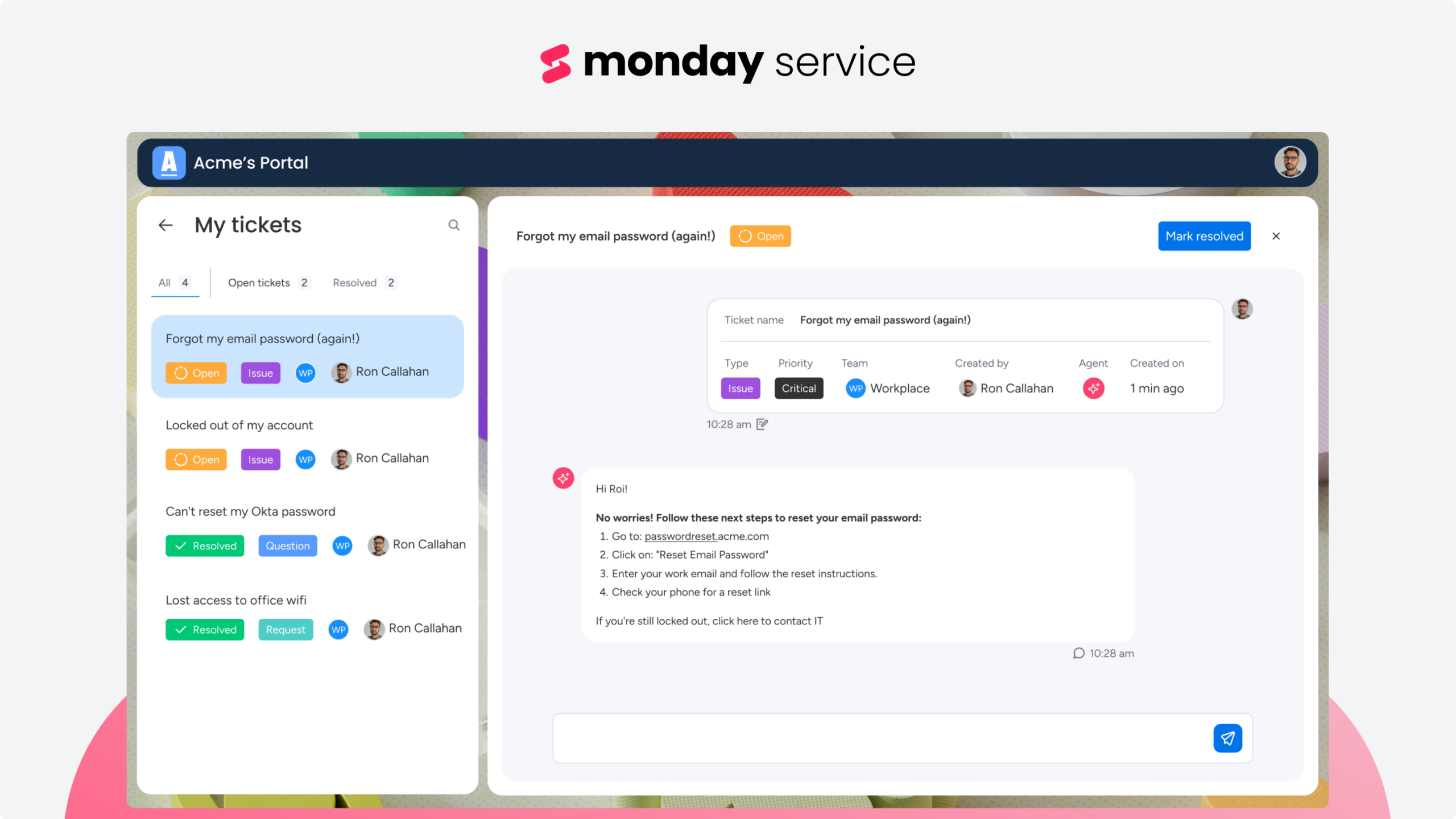
- Customer portal — external or internal end users submit requests, see ticket status, and find solution suggestions.
- Knowledge base articles — structured solution database, integrated with tickets and searchable.
- AI-supported reply suggestions — monday AI proposes responses based on similar resolved tickets.
Automation and workflows
- No-code automations — trigger-action recipes for recurring service steps: escalation, re-assignment, status updates, notifications.
- Approval workflows — multi-step approval loops with defined ownership.
- Cross-board workflows — tickets can be automatically passed into other monday products (Dev, CRM, Work Management).
Integration and extensibility
- Native integrations — Microsoft 365, Outlook, Gmail, Slack, Microsoft Teams, Jira, Salesforce, Okta, Azure AD, and many more.
- GraphQL API and webhooks — custom integrations via Make.com, Zapier, or proprietary connectors.
- Cross-product linking — seamless data flows between monday service and monday dev, CRM, work management on a shared data layer.
Governance and compliance
- Permissions and privacy — granular rights at workspace, board, item, and column level; private boards for confidential service data.
- Single sign-on (SAML/SCIM), audit logs — enterprise-ready; SOC 2, ISO 27001, GDPR-compliant; EU data centers available.
Our services for monday service
We support monday service projects in six progressive steps. Depending on maturity and service complexity, we combine the services modularly:
- Discovery and service use-case assessment. We analyze existing service processes, ticket volumes, escalation paths, SLA requirements, and tool landscape — and prioritize the service areas with the strongest business impact.
- Service setup and workflow design. Building ticket structures, status models, SLA definitions, routing rules, escalation logic, approval workflows, and permission models.
- Self-service portal and knowledge base. Configuration of the customer portal, building the initial knowledge base structure, migration of existing knowledge articles, integration into self-service flows.
- Integration with identity and stack systems. Connection to SSO (Azure AD, Okta), Microsoft 365, Slack, Salesforce, Jira, plus ITAM or monitoring tools where relevant — via native integrations, Make.com, Zapier, or custom-built connectors.
- Migration from existing systems. Data migration from Zendesk, Jira Service Management, Freshdesk, ServiceNow, older helpdesk solutions, or email/Excel-based ticketing — including mapping of status values, categories, SLA definitions, and ticket history.
- Enablement, training, and adoption. Training for service agents, service leadership, admins, and end users. Establishing an operating model including SLA review, knowledge maintenance, and licensing processes.
The approach is iterative: first productive service use cases in four to six weeks, further extensions as needed.
Why antegma as your partner for monday service
Iterative methodology
First productive service use cases in four to six weeks. Scaling across service areas, locations, or brands follows once the core is stable.
DACH presence
Consulting and implementation in German and English, with teams in Munich and St. Georgen. Data processing in the EU, one time zone, one legal framework — relevant for service data under GDPR.
Integration with identity and stack systems
SSO via Azure AD or Okta, Microsoft 365 depth, connections to Salesforce, Jira, and ITSM neighboring systems — via Make.com, Zapier, or custom-built connectors.
Migration experience from classic helpdesks
We have migrated service teams from Zendesk, Jira Service Management, Freshdesk, ServiceNow, and older solutions to monday service — with SLAs, categories, and ticket history.
Cross-functional service experience
We use monday service not only for classic IT service desks, but also for HR, facility, procurement, and external customer support — with a coherent platform architecture.
Certified monday.com partner
antegma is officially certified as a monday.com partner. Service architectures, integrations, and recommendations reflect the current state of the platform.
Ready for your monday service rollout?
Whether you’re rolling out monday service, replacing an existing helpdesk tool, or deciding between monday service, Zendesk, Jira Service Management, or Freshdesk, we start with an initial conversation. The outcome: a clear picture of your starting point, prioritized service areas, migration effort, and an implementation roadmap.
Want to try monday service yourself first? Start for free via our partner link.
If a contract is signed via our partner link, antegma receives a referral commission from monday.com. There are no additional costs for you.
You might also be interested in

How Unified Review and Approval brings creative alignment and formal approval together
An approval goes out, two of five people respond. The rest stay silent. The item sits there, and not because someone objects, but because nobody

How Adobe Cloud Storage simplifies and speeds up collaboration
The same asset exists three times over: as a working file on the desktop, as a copy in Adobe Workfront, and as the approved version

Operating Model, Not Tools: How the Content Supply Chain Becomes Agentic (Adobe Summit 2026)
Adobe Summit 2026: 80 % of brands struggle with data foundation. The five pillars of an agentic Content Supply Chain — and antegma’s operating-model framework.
Frequently asked questions about monday service
What is monday service?
monday service is the service desk and ticketing solution of the monday.com platform. Service teams manage tickets, requests, SLAs, and knowledge base articles in flexible boards. Multi-channel intake (email, portal, Slack/Teams), automatic routing, SLA tracking with escalation, and a self-service portal are included. Through the API and native integrations, monday service connects to identity providers, Microsoft 365, Salesforce, Jira, and 1,500+ other applications — and can be linked cross-functionally with monday CRM, work management, and dev.
When is monday service the right choice compared to Zendesk or Jira Service Management?
Both alternatives are strong service platforms but built for different profiles. Zendesk is classically customer-support-centric with strong omnichannel depth — well-suited for high-volume external support. Jira Service Management is the Atlassian choice with ITIL depth — well-suited when engineering and service are tightly interwoven and the rest of the stack runs on Atlassian. monday service plays its strength when cross-functional service (IT + HR + Facility + Customer Support) should run on a single platform, when workflows should remain visually configurable, and when rollout must happen in weeks. antegma advises vendor-neutrally.
Which service areas can be mapped to monday service?
monday service isn’t limited to a single service area. In our projects, customers typically use the product for a combination of IT service desk, internal employee service (HR, facility, procurement, legal), and external customer support. Each area gets its own boards with its own status models, SLAs, and permissions, but shares the platform, reporting logic, and common end-user portals. The cross-functional setup is one of the central differentiators compared to specialized helpdesks.
From which service tools does antegma typically migrate?
We have carried out migrations from Zendesk, Jira Service Management, Freshdesk, ServiceNow, older on-premise helpdesks (e.g. OTRS, BMC Remedy), and from email- or Excel-based ticketing. We migrate tickets, status models, categories, SLA definitions, knowledge articles, and — where technically sensible — ticket history and attachments. Complex workflow logic is mapped in the migration concept; outdated status models are professionalized along proven patterns during the migration, rather than carrying forward existing weaknesses 1:1.
How long does a monday service rollout take?
A first productive service use case — such as an IT service desk board with defined SLAs and routing, or an HR request workflow — is typically achievable in four to six weeks. More complex scenarios such as multi-area setups (IT + HR + Facility + external support simultaneously), deep integration into ITSM neighboring systems, or migrations of large Zendesk/Jira data sets extend the timeline accordingly. What matters is an early working core that the service organization learns from and against which further areas are prioritized.
Which industries does antegma support on monday service projects?
antegma works with service organizations in consumer goods, B2B e-commerce, mechanical engineering, financial services, and mid-market industry — with a focus on structured service processes and SLA discipline. The methodology is cross-industry: we combine multi-year experience in service architecture and ITSM neighboring systems with the flexibility of monday service. Industry-specific adaptations — such as regulatory requirements for service data under GDPR or specialized compliance workflows in highly regulated industries — are addressed during the discovery and architecture phase.
From which service desk tools does antegma typically migrate to monday service?
We have carried out migrations from Zendesk, Freshdesk, ServiceNow ITSM, Jira Service Management, Microsoft Dynamics 365 Customer Service, Spiceworks, as well as from email-inbox-driven ad-hoc service. We migrate open tickets, ticket history, customer and contact data, SLA definitions, knowledge base articles, and — where technically sensible — attachments and internal notes. In the migration concept, service processes are often professionalized (e.g. clean category taxonomy, clear SLA tiers) rather than carrying forward existing weaknesses 1:1.
How much does monday service cost?
monday service is licensed by user tier (Basic, Standard, Pro, Enterprise) and number of service agents. List prices are published on monday.com/pricing. End customers who only submit tickets don’t need a license. As part of our consulting, we help select the right tier — Pro is enough for most internal IT and support desks; Enterprise is worthwhile when you need an SLA engine, multi-region setup, or extended audit requirements.
Is monday service GDPR-compliant? Where is ticket data stored?
Yes. monday.com is GDPR-compliant, signs a DPA, and operates data regions in the EU (Frankfurt / AWS EU-Central). The platform holds SOC 2 and ISO 27001 certifications. Service tickets often contain personal data (end-customer contacts, request content) — we support with DPA sign-off, permission concept (who sees which tickets), retention rules per GDPR Art. 17, and configuration of private boards for particularly sensitive service cases (e.g. HR requests, compliance reports).
Why antegma as an implementation partner for monday service?
Three points: first, we are a certified monday.com partner — service setup, SLA engine, routing rules, and integrations reflect the current state of the platform. Second, we bring service-operations depth (ITIL basics, SLA modeling, knowledge base structures, escalation paths). Third, we have experience with cross-product setups: linking monday service seamlessly with monday CRM (for existing-customer service) or monday work management (for service projects), rather than building isolated service silos.
What results do service teams achieve with monday service after rollout?
A first productive service-desk rollout — such as internal IT support for a defined employee cluster — is live in four to six weeks. Service teams report falling first-response times, higher SLA compliance, better visibility into ticket volume and backlog, and less duplicate work because tickets land in a structured board rather than an email inbox. With AI-supported classification and reply suggestions, manual triage load drops further.