
Creating Accessible Digital Experiences for Everyone
At antegma, we specialize in consulting and implementation in the field of digital accessibility for websites and digital channels to ensure that your digital offerings meet the highest standards of inclusion and compliance. Moreover, digital accessibility is not just a legal obligation – it is a promise to provide equal access to all users across all channels and devices. Therefore, our services support companies in adapting to new regulations while improving user-friendliness.
What barriers do we address with Digital Accessibility?
Digital Accessibility means identifying and eliminating obstacles that prevent certain user groups from fully using your website, app, or platform. However, these barriers are avoidable if you take the right measures. Here are the main barriers we address in your digital offerings:
Visual Barriers
Visual barriers often arise when content is difficult to read or not accessible to screen readers. For example, insufficient contrast between text and background, missing alt text for images, or small font sizes make it difficult for users with visual impairments. With our support, these barriers are minimized by developing clear and readable designs that are accessible to all users.
Auditory Barriers
Auditory barriers occur when videos or audio content lack alternative options. Without captions or transcripts, these contents are inaccessible to people with hearing impairments. Therefore, we implement solutions such as automatic subtitles, audio descriptions, and intuitive audio controls to ensure that your content is accessible to everyone.
Motor and Physical Barriers
Cognitive Barriers
Technological Barriers
Linguistic Barriers
Channels and Devices affected by Digital Accessibility Regulations
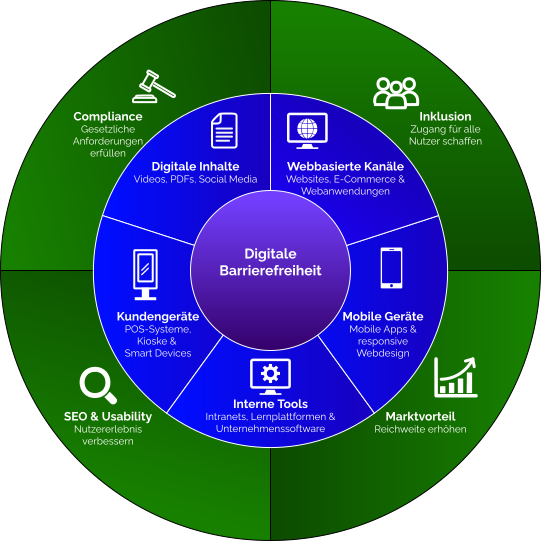
The EU Accessibility Act 2025 (German version: Barrierefreiheitsstärkungsgesetz / BFSG) as well as other accessibility standards affect a variety of digital channels and devices. For instance, the following areas are particularly important:
- Web-based Channels: Websites, web applications, and e-commerce platforms.
- Mobile Devices: Mobile apps and responsive websites.
- Customer Devices: Interactive kiosks, POS systems, and smart devices.
- Internal Platforms: Intranets, learning management systems, and enterprise software.
- Digital Content: Videos, PDFs, and social media content.
With our services for digital accessibility, you ensure that your digital offerings are accessible to every user.
Why Digital Accessibility Across All Channels Is Important
Improved User-Friendliness
Accessible design benefits all users, not just people with disabilities. Moreover, it leads to higher user satisfaction and loyalty.
Enhanced Search Engine Performance
Accessible websites are compatible with Google Core Web Vitals and improve rankings. Thus, you benefit from better visibility and organic traffic.
Legal Compliance
Regulations such as the EU Accessibility Act require adherence to accessibility standards for a variety of digital channels and devices. Without this, companies risk fines and reputational damage.
Social Responsibility
Inclusion demonstrates your commitment to diversity and equality. Therefore, it strengthens trust and loyalty among your target audience.
Our Services for Digital Accessibility
Digital Accessibility is not just a legal obligation but also an opportunity to make your digital experiences accessible to everyone. Thus, we have divided our services into four clearly defined packages that support companies on their way to digital inclusion. These packages cover every step, from analysis to implementation and long-term maintenance and training.
Analysis and Strategy Package
The analysis and strategy package is designed for companies that want to know where they stand in terms of digital accessibility and need a clear roadmap for improvements. In this package, we conduct a comprehensive digital accessibility audit, analyzing your digital offerings using state-of-the-art tools like axe, Lighthouse, and WAVE. This analysis provides you with a detailed assessment of existing problems as well as clear recommendations. Based on the results, we develop a tailored strategy precisely aligned with your company’s needs. Thus, we create a solid foundation for the next steps toward accessibility.
Implementation Package
The implementation package is ideal for companies looking to take practical steps to improve their digital accessibility. Here, we implement specific solutions, such as adding alt texts to images, optimizing ARIA roles, and improving keyboard navigation. Additionally, we ensure that designs are adjusted to meet WCAG standards for colors, font sizes, and layouts. Multimedia content is also considered, as we integrate captions, transcripts, and audio descriptions. This package ensures that your digital offerings not only meet legal requirements but are also accessible to all users.
Monitoring and Maintenance Package
Digital Accessibility is not a one-time process but an ongoing task. That’s why we developed our monitoring and maintenance package. At regular intervals, we review your digital offerings to ensure they continue to meet the latest standards. Should new requirements or challenges arise, we adapt your content and systems accordingly. Additionally, you have a dedicated contact person who supports you with changes in regulations and technologies. This package gives you the confidence that your accessibility is guaranteed in the long term.
Training Packages
Digital Accessibility starts with knowledge. Our specially developed training packages help your team understand and apply the fundamentals and best practices of digital accessibility in their respective fields. Whether developers, designers, or content creators – our training empowers your teams to work inclusively and in compliance with the law.
Training for Developers in Digital Accessibility
Optimize your digital infrastructure for accessible design.
Our training package for developers offers practical knowledge to integrate digital accessibility into the development process from the beginning. Your developers will learn how to write clean, compliant code that is accessible to all users.
Training Content
- Introduction to WCAG guidelines and the EU Accessibility Act.
- Use of semantic HTML and ARIA attributes.
- Accessible navigation: keyboard controls and screen reader compatibility.
- Testing tools like axe and Lighthouse for automated accessibility audits.
This package is ideal for development teams looking to expand their technical skills and create accessible digital products.
Training for Designers in Digital Accessibility
Create engaging and inclusive experiences.
Our training package for designers covers the foundations of accessible design and demonstrates how inclusive design can be both aesthetic and functional. The goal is to address the needs of all users without compromising creativity.
Training Content
- Contrast ratios, color schemes, and font sizes for maximum readability.
- Creation of accessible user interfaces (UI/UX).
- How to design animations and interactions for accessibility.
- Tools and methods to test design solutions for accessibility.
This package is especially suited for UX/UI designers, art directors, and design teams looking to create user-friendly and accessible experiences.
Training for Content Creators and Marketers in Digital Accessibility
Create accessible content that reaches all users.
Content plays a central role in digital accessibility. Our training package for content creators and marketers helps you develop content that is accessible, engaging, and SEO-optimized, ensuring your messages reach everyone.
Training Content
- Writing accessible texts that are clear and easy to understand.
- Use of alt text and image descriptions for SEO and accessibility.
- Creating accessible PDFs, videos, and social media content.
- Tools and processes to check content accessibility.
This package is ideal for content teams, social media managers, and marketing professionals aiming to communicate inclusively and effectively.
Future-Proofing Your Digital Presence
Antegma ensures that your digital content not only meets today’s accessibility requirements but is also prepared for the future. We help you adapt to the upcoming EU Accessibility Act (2025) and keep pace with evolving WCAG standards, ensuring you stay ahead.
Why Choose antegma as Your Partner for Digital Accessibility?
Proven Expertise: Our team has years of experience with accessibility standards and their implementation across various industries.
Scalable Solutions: We tailor our services to the specific needs of your business, whether you are building a new platform or optimizing an existing one.
Future-Proof Compliance: Stay ahead of the curve by preparing for upcoming regulations like the EU Accessibility Act and ensuring your digital resources are ready for 2025 and beyond.
Are you ready to improve the digital accessibility of your digital experiences?
This could also interest you
Frequent asked questions about Digital Accessibility
What is the Barrierefreiheitsstärkungsgesetz (BFSG)?
The Barrierefreiheitsstärkungsgesetz (BFSG), or German Accessibility Strengthening Act, is Germany’s implementation of the European Accessibility Act (EAA) and came into force on June 28, 2025. The law requires businesses to make certain products and services accessible so that people with disabilities, older individuals, and those with temporary impairments can have equal access.
Which businesses are affected by the BFSG?
The BFSG applies to manufacturers, importers, distributors, and service providers offering products or services to consumers (B2C). This includes operators of online shops, e-commerce platforms, banks, telecommunications providers, and passenger transport services. Pure B2B offerings are generally not covered by the law.
Are there exemptions for small businesses?
Yes, microenterprises are exempt from the BFSG when providing services. A microenterprise is defined as having fewer than 10 employees and an annual turnover or balance sheet total of no more than 2 million euros. Important: This exemption only applies to services – for products such as hardware or software, even microenterprises must comply with the requirements.
Which digital offerings must be accessible?
The BFSG covers a wide range of digital offerings, including websites and web applications in e-commerce, mobile apps, e-books and e-readers, self-service terminals (e.g., ATMs, check-in kiosks), banking services, telecommunications services, and passenger transport services. Digital content such as PDFs must also be designed to be accessible.
Which technical standards do I need to meet?
The specific requirements are defined in the Barrierefreiheitsanforderungsverordnung (BFSGV – German Accessibility Requirements Regulation) and are based on the European standard EN 301 549 as well as the Web Content Accessibility Guidelines (WCAG 2.1, Level AA). The basic principle is that content must be perceivable through at least two senses – for example, through text alternatives for images or captions for videos.
Is an overlay tool or accessibility widget sufficient?
No, overlay tools and widgets typically do not meet the legal requirements. These tools only add an additional layer over your website but do not fix the fundamental accessibility issues in the source code. Sustainable compliance requires a structural overhaul of your digital offerings.
Do I need to publish an accessibility statement?
Yes, businesses must publish an accessibility statement on their website. This statement must document the current state of accessibility, include a feedback mechanism for users, and provide information about the relevant arbitration body. The statement should also be available in German Sign Language (DGS) and Easy Language.
What penalties apply for non-compliance?
Violations of the BFSG can result in fines of up to €100,000. Additionally, market surveillance authorities can restrict or prohibit the provision of products or services. There is also the risk of cease-and-desist warnings from competitors or consumer protection associations, as well as reputational damage.
Are there transition periods?
Websites and online shops have been required to be accessible since June 28, 2025 – no transition periods apply here. For services provided using certain products, a transition period until June 2030 applies. Self-service terminals installed before the deadline may continue to be used until 2040 at the latest.
What benefits does accessibility offer beyond legal compliance?
Accessibility offers numerous benefits: You reach a larger target audience (approximately 10 million people with disabilities in Germany plus older adults), improve your search engine optimization (SEO) as accessible websites align with Google Core Web Vitals, enhance overall usability for all users, and demonstrate social responsibility, which strengthens trust and customer loyalty.
How can I check if my website is accessible?
Automated tools such as axe, Lighthouse, or WAVE can provide an initial assessment. However, these tools only detect approximately 30–40% of potential barriers. A comprehensive evaluation requires a professional audit that combines automated tests, manual reviews, and testing with assistive technologies. antegma offers comprehensive accessibility audits as part of its Analysis and Strategy Package.
How long does it take to implement digital accessibility?
The duration depends on the current state of your digital offerings and their complexity. For a simple website, implementation can take a few weeks, while extensive e-commerce platforms may require several months. It is important to start with an analysis early and plan the implementation in stages. antegma supports you from the initial analysis through implementation to long-term maintenance.